
Exhibitor Density Benchmarks: How Many Booths Should Your Show Sell?
Data from 84 conference and trade show floors shows how exhibitor count scales with attendance and how many attendees a booth needs to justify its price.
August 31, 2026
Most organizers set their exhibitor count by feel: how many booths fit in the hall, how many their predecessor sold last year, or how many a sales rep thinks they can close. Public prospectus data from 84 conference and trade show floors researched in 2026 shows a more consistent pattern than that feel-based approach usually produces, and it holds a real surprise: the ratio of attendees to exhibitors is not constant as events grow. Larger shows carry proportionally fewer exhibitors per attendee, not more.
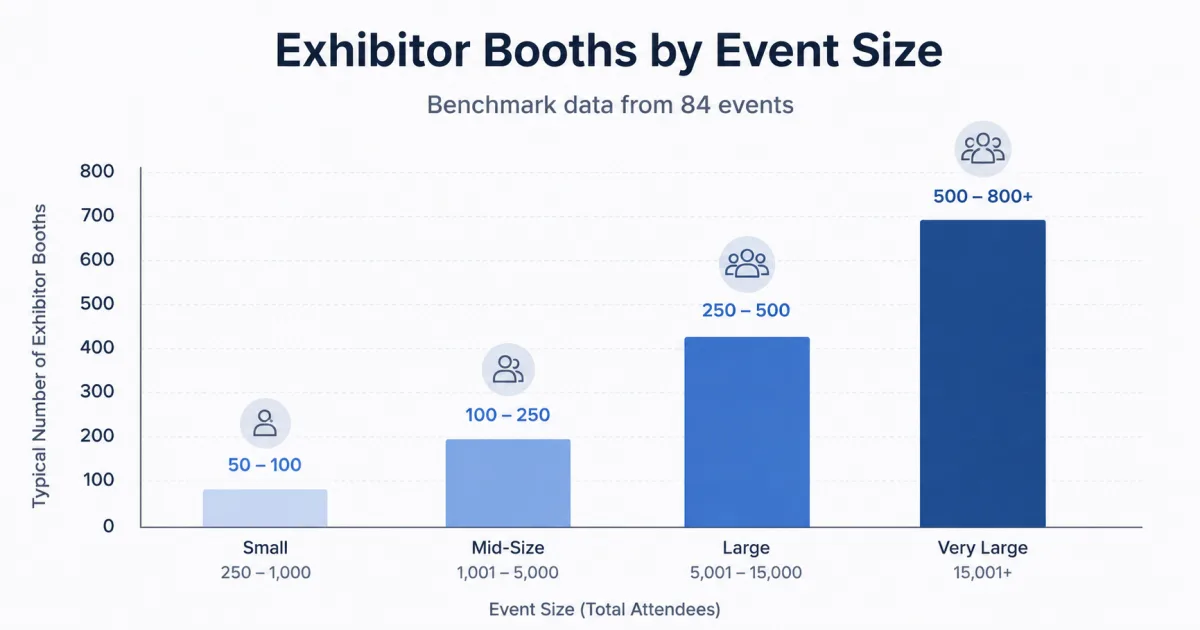
This data comes from public event prospectuses and marketing materials gathered while researching conference and trade show prospects during 2026, not a survey or a paid research panel. It is a first cut, not a definitive market study, and the underlying dataset will grow as more events get researched. No individual organization's data is named or attributed below. Every figure is an aggregate statistic computed across the set.
The dataset
84 events, spanning trade shows, professional association annual meetings, and membership-organization conventions, primarily in the 200 to 30,000 attendee range. Three events were excluded from the benchmark calculations below: two large public consumer expos and one very large public auto show, all of which draw general public attendance rather than a curated buyer audience, and all of which showed an attendees-per-exhibitor ratio far outside the range of every other event in the set (over 150 attendees per exhibitor, versus a median of roughly 13 across the remaining 76 events). Excluding those three keeps the benchmark relevant to the B2B trade show and conference organizers this data is meant to help, not skewed by a handful of events with a structurally different attendee mix.
Across the remaining 76 events, exhibitor count ranged from 12 to 700 booths, with a median of 175. That range reflects real diversity in event type: a single-track professional association meeting sells far fewer booths than a category-wide industry trade show, even at similar attendance.
Exhibitor count by event size
Grouping the 76 events by total attendance shows exhibitor count scaling with event size, but not at a constant rate.
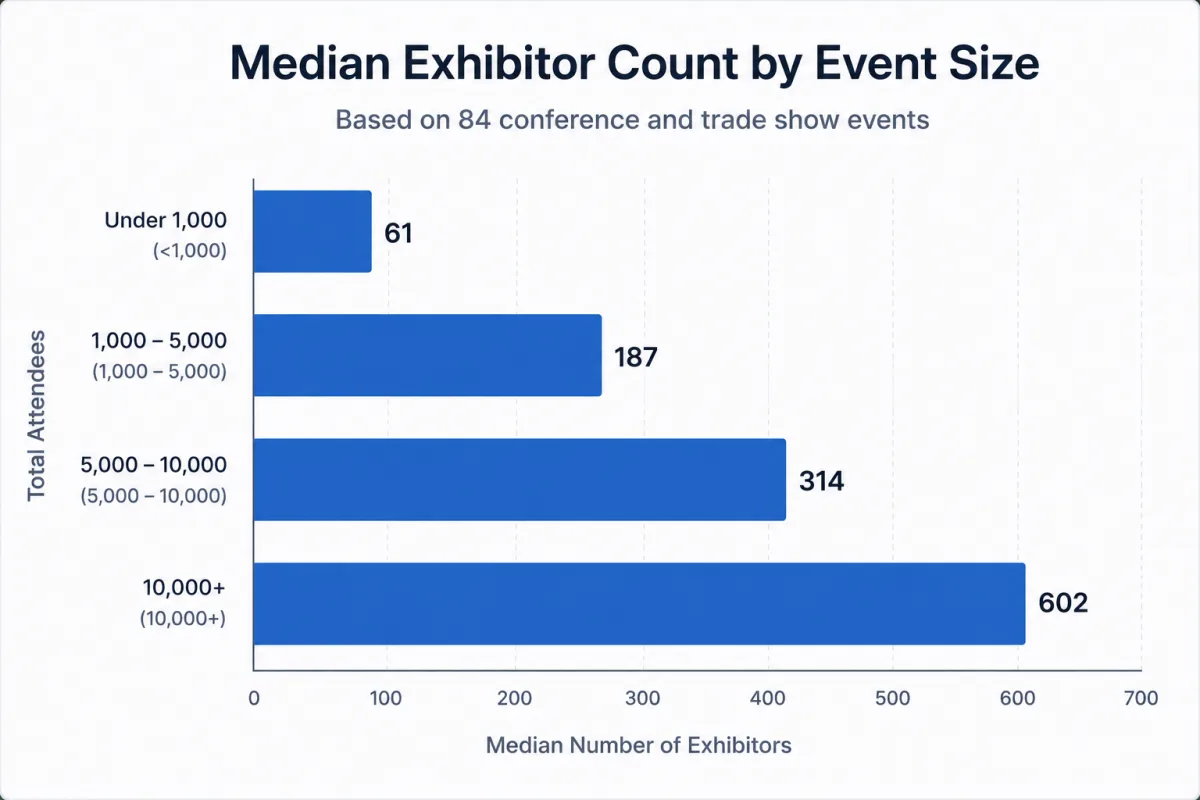
Under 1,000 attendees (15 events in the set): median 70 exhibitors, ranging from 20 to 180. Median ratio: roughly 10 attendees per exhibitor.
1,000 to 5,000 attendees (39 events, the largest group in the dataset and the range VenueSight is built around): median 170 exhibitors, ranging from 12 to 350. Median ratio: roughly 12 attendees per exhibitor.
5,000 to 10,000 attendees (14 events): median 394 exhibitors, ranging from 175 to 700. Median ratio: roughly 18 attendees per exhibitor.
Exhibitor Revenue
What could lead retrieval earn your show?
Lead retrieval is built in, so the fees exhibitors pay a third-party vendor today can go to your show instead. See the number for your floor.
10,000+ attendees (8 events): median 580 exhibitors, ranging from 148 to 2,335. Median ratio: roughly 33 attendees per exhibitor.
The pattern: as attendance grows, exhibitor count grows too, but more slowly. A show with 10x the attendees of a small event does not have 10x the exhibitors. This tracks with what most experienced organizers would expect intuitively (there's a practical ceiling on how many relevant vendors exist for most industries, and floor space itself becomes a constraint at scale), but seeing it as a consistent ratio across dozens of independently researched events is more useful than intuition alone when you're setting your own booth count for the first time or deciding whether to expand the floor.
What this means if you're setting your own exhibitor count
If your event falls in the 1,000 to 5,000 attendee range and you're currently selling under 100 booths, the benchmark above suggests there may be real room to grow the floor before you outgrow what your audience size can reasonably support. If you're already above 200 booths at that same attendance level, you're already ahead of the median and should think carefully about whether your venue and traffic flow can support further growth before adding more exhibitors, since booth ROI for exhibitors depends on enough attendee traffic reaching every booth, not just the booth count on paper.
The ratio also gives you a sanity check on exhibitor pricing conversations. An exhibitor asking "how many people will actually walk by my booth" is really asking about attendees-per-exhibitor. A show at the 1,000 to 5,000 tier median (roughly 12 attendees per exhibitor) has a meaningfully different pitch to make than a show at the 10,000+ tier median (roughly 33 attendees per exhibitor), and pricing should reflect that difference in exhibitor value, not just total attendance.
A caveat on what this data can't tell you
Attendee and exhibitor counts say nothing about attendee quality, buying authority, or how many minutes an average attendee actually spends on the floor. A 1,000-attendee association meeting of senior decision-makers can be a better exhibitor investment than a 10,000-attendee show with a broader, less-targeted audience, even at a worse attendees-per-exhibitor ratio. Use this benchmark to sanity-check your booth count against events of similar scale, not as a substitute for understanding your own audience.
Running Exhibitor Sales with VenueSight
VenueSight's exhibitor management tools make it straightforward to track where your event sits against benchmarks like these. Booth inventory, pricing tiers, and sold-versus-available counts are visible in real time as you sell, so you can see your actual exhibitor density building throughout your sales cycle instead of finding out at the end. Interactive floor plans let exhibitors self-select booths as they reserve, and native lead retrieval gives you a second revenue lever once the floor is built, letting you charge exhibitors for badge-scanning access instead of routing that revenue to an A/V vendor.
If you're planning your next event's exhibitor floor, see how VenueSight's trade show platform handles booth sales, floor plans, and exhibitor management in one system, or book a walkthrough of your own event's setup.