Exhibitor Lead Retrieval Software: A Buyer's Guide for Organizers
Lead retrieval software isn't one category. Learn the three models organizers choose between and how to pick the one that fits your event and exhibitors.
October 6, 2026
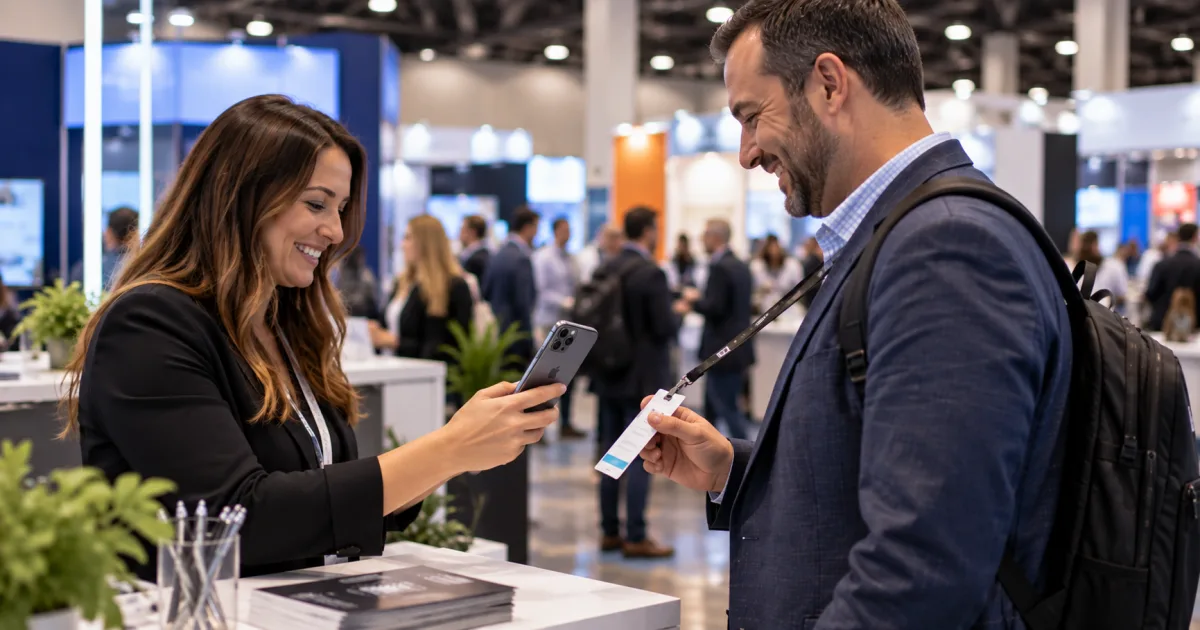
Lead retrieval software lets exhibitors scan attendee badges at their booth to capture contact information, usually with a qualification tag and a note field attached, then export that record to their own CRM. That single description covers three genuinely different products with three different cost structures and three different answers to who keeps the revenue. Organizers searching for lead retrieval software are usually comparing apples to oranges without realizing it, and picking the wrong model is one of the more common, most avoidable mistakes in exhibitor management.
What Lead Retrieval Software Actually Does
At its core, lead retrieval solves one problem: an exhibitor talks to hundreds of people over the course of a show, and there is no realistic way to remember, transcribe, or hand-write that many contacts accurately. A scan replaces the business card exchange and the handwritten note. The attendee's badge, whether it carries a QR code, a barcode, or an NFC chip, gets read by a phone, a dedicated scanner, or a tablet at the booth. The system pulls whatever registration data the attendee provided (name, company, title, sometimes contact information depending on your event's data-sharing settings) and attaches it to the exhibitor's account.
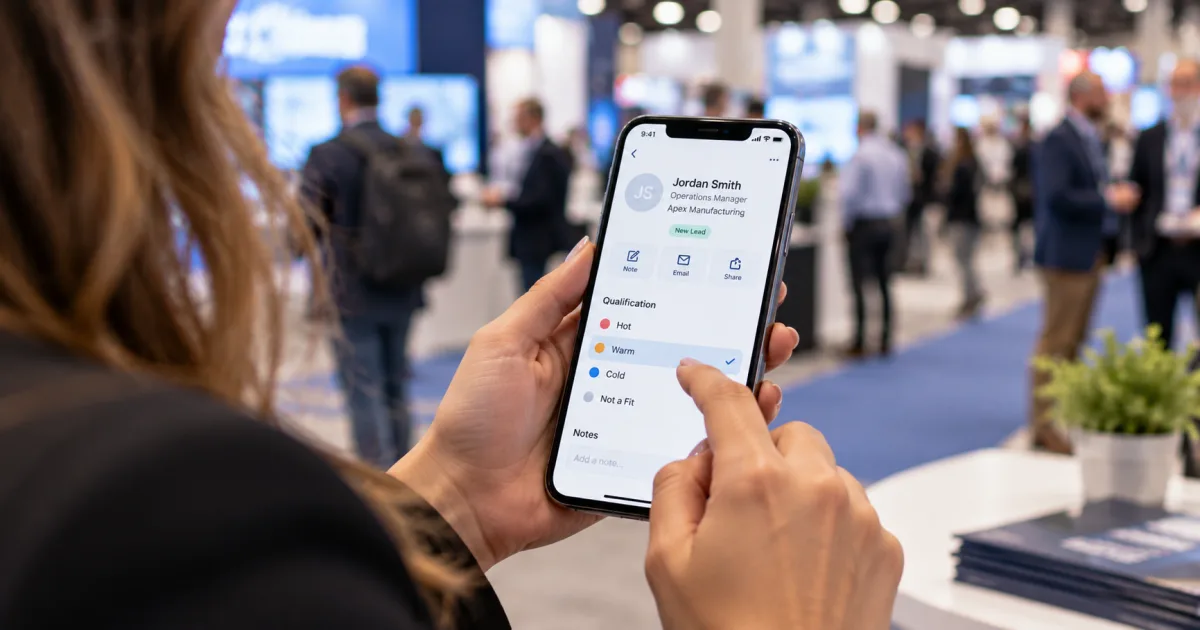
What separates a good implementation from a mediocre one is what happens in the ninety seconds after the scan and the days after the show. Good lead retrieval lets the booth staffer add a qualification tag (hot, warm, cold) and a short note while the conversation is still fresh, rather than relying on memory later. Good lead retrieval exports that record to the exhibitor's CRM within minutes or hours, not after the show closes. Mediocre lead retrieval is a scan that gets stored somewhere and handed over as a spreadsheet a week later, by which point the exhibitor's sales rep has forgotten which of the forty people they talked to actually said something interesting.
This distinction matters because lead quality drives exhibitor ROI far more than lead quantity does, and lead retrieval software is the mechanism that either preserves or destroys that quality between the booth conversation and the follow-up call.
The Three Models Organizers Choose Between
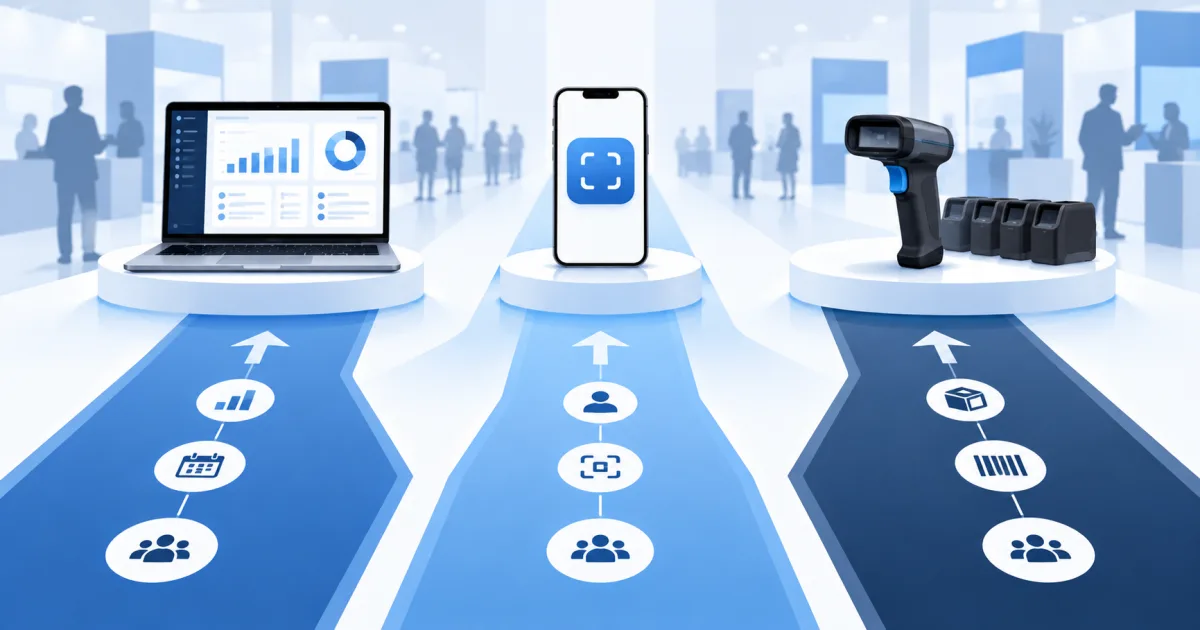
Search "lead retrieval software" and every result describes roughly the same scanning function. The real decision organizers face is not about features. It is about which of three underlying business models they are buying into.
Built Into Your Registration Platform
If the software you already use for registration and badge printing also offers lead retrieval as a feature, exhibitors buy access as an add-on tied to badges the system already issued. There is no separate app to install, no separate hardware to coordinate, and no additional vendor relationship for your team to manage. The organizer typically sets the price exhibitors pay and keeps that revenue directly.
This model tends to work best operationally because your registration data, your exhibitor list, and your lead retrieval scans all live in the same system from the start. There is nothing to reconcile after the show because there was never a second database to keep in sync.
A Standalone Third-Party App
A dedicated lead retrieval product that plugs into whatever registration and badging system you already run, usually by reading a QR code, barcode, or NFC chip your platform already generates. Exhibitors typically buy licenses directly from the third-party vendor. Sometimes organizers negotiate a referral commission on those sales; sometimes they do not, and the entire transaction happens outside the organizer's own revenue stream.
Standalone apps are the common choice when an organizer's core registration platform has no lead retrieval feature at all, or when exhibitors specifically request a tool they have used successfully at other shows and trust already. The tradeoff is coordination: your team now has to onboard exhibitors onto a second system, make sure badge formats are compatible, and field support questions about a tool you did not build and may not fully control.
A Rented A/V Vendor Scanner
The traditional model at many venue-managed conferences and convention-center events: exhibitors rent handheld scanners, or scanner-equipped tablets, from the show's official audio-visual or general-services contractor, priced per device per day. This has been the default for decades at large convention centers where the venue's preferred vendor list controls what equipment can be brought onto the floor.
It is also, in practice, the most expensive model per exhibitor of the three, once you account for daily device rental fees stacked across a multi-day show and multiple booth staff needing their own unit. Critically, the revenue from those rentals goes to the A/V contractor, not to the organizer, unless there is a specific revenue-share arrangement negotiated into the show services contract. Many organizers we talk to have never asked whether that revenue-share exists, largely because lead retrieval has historically been treated as a logistics line item rather than a monetizable feature of the event itself.
Comparing the Three ModelsThree models most organizers choose between
A few patterns hold consistently across events we have looked at:
Cost to exhibitors tends to run lowest for built-in platform features, moderate for standalone apps, and highest for A/V rentals, largely because A/V pricing is structured around daily device rental rather than a flat per-event license.
Setup coordination for organizers is lowest for built-in features (nothing new to configure), moderate for standalone apps (badge format compatibility, exhibitor onboarding), and lowest again for A/V rentals in a different sense: the A/V vendor handles logistics, but you lose visibility into and control over the exhibitor experience.
Revenue ownership sits with the organizer for built-in platform features, is negotiable for standalone apps, and typically sits with the A/V vendor for rented scanners unless a specific contract clause says otherwise.
Data portability varies most within the standalone app category, since some third-party tools export cleanly to any CRM and others lock data into their own dashboard with limited export options.
None of these three models is universally correct. The right choice depends on what you are already running, how much control you want over the exhibitor experience, and whether lead retrieval is a cost center you tolerate or a revenue line you actively manage.
What to Evaluate Before You Commit
Once you know which model fits your situation, a handful of specific questions separate a good choice from a costly mistake.
What to evaluate with lead retrieval
Does it work with badges you already print, or does it need its own? Some standalone tools require exhibitors to run a proprietary scanning app that reads your platform's existing badge format. Others need an entirely separate exhibitor badge and scanner pairing, which means printing, distributing, and troubleshooting a second credential system on top of your existing one. Every extra piece of hardware or app an exhibitor has to bring to the booth is friction, and friction shows up as fewer leads captured, not more, because booth staff skip the extra step when things get busy.
Who owns the exported data, and when do exhibitors actually receive it? Real-time export, meaning leads land in the exhibitor's CRM the same day, ideally within minutes, is table stakes for any exhibitor with a sales-driven follow-up process. A tool that only produces a spreadsheet after the show closes is effectively asking a sales rep to wait a week to follow up on a conversation that happened on day one. Most of that lead's urgency, and a meaningful share of the actual buying intent, evaporates in that gap.
Does it support qualification at the point of capture? A raw badge scan gives an exhibitor a list of names. A scan with a hot, warm, or cold tag and a short note gives an exhibitor a prioritized call list. The difference matters more to exhibitor-reported satisfaction than scan speed does, because exhibitors do not actually care how fast the scan happens; they care how useful the resulting list is three days later.
What does it cost per booth, not per scan or per device? A la carte per-device daily rates from an A/V vendor look inexpensive in isolation and expensive in aggregate once multiplied across however many staff a booth runs and however many days the show lasts. Always ask for the all-in cost per booth for your typical exhibitor footprint, not the headline per-unit rate quoted in a sales conversation.
Can you set the price, or is it fixed by a third party? This is the difference between lead retrieval as a coordination cost you pass through and lead retrieval as a genuine revenue line for your event. If your platform lets you set exhibitor-facing pricing for lead retrieval access, that revenue belongs to you. If exhibitors pay an outside vendor directly, it does not, regardless of how much value your event's attendee list provides to that transaction.
How does it hold up on real show-floor WiFi and cellular coverage? Convention center connectivity is notoriously inconsistent, and a lead retrieval tool that requires a constant live connection to function will fail exactly when a booth is busiest. Ask vendors directly whether scans queue and sync when connectivity drops, or whether a dead zone means lost leads.
Exhibitor Revenue
What could lead retrieval earn your show?
Lead retrieval is built in, so the fees exhibitors pay a third-party vendor today can go to your show instead. See the number for your floor.
Hardware: Bring-Your-Own-Phone Versus Dedicated Devices
Most modern lead retrieval tools work through a phone the booth staffer already owns, using the camera to read a QR code or an NFC reader built into recent phone models. This bring-your-own-device approach is cheaper, since exhibitors are not paying to rent equipment, and it means booth staff are using a device they already know how to operate under pressure. The downside is variability: not every exhibitor's staff has a compatible phone, battery life becomes the exhibitor's problem rather than the vendor's, and a lost or forgotten phone means a booth with no scanning capability until someone finds a replacement.
Dedicated devices, whether provided by a standalone lead retrieval vendor or rented through an A/V contractor, solve the compatibility and battery problems at the cost of a per-device fee and one more piece of equipment for exhibitors to manage, charge, and return at the end of the show. For a small booth with one or two staff, bring-your-own-phone is almost always the more practical choice. For a large booth running multiple simultaneous conversations, a mix of both, personal phones as backup and one or two dedicated devices for the busiest hours, tends to work better than forcing every staffer onto the same hardware model.
Ask any vendor directly which approach their tool supports, and if it supports both, ask whether switching between them mid-show requires any reconfiguration. A tool that only works well with one hardware approach is a meaningful limitation worth knowing about before the show, not during it.
What Happens to the Data After the Show
A scan is only valuable if what happens next is fast and organized. Exhibitors who get real-time export spend the show itself watching leads accumulate in their CRM, which means their sales team can start research and outreach before the show even closes, particularly useful for booths that run three or four full days. Exhibitors stuck with a post-show spreadsheet export are starting that same research and outreach process a week or more later, competing with every other task that piled up while their team was out of the office at the event.
The best lead retrieval tools also preserve the qualification tags and notes captured at the booth when they export, so a sales rep opening a new CRM record sees not just a name and company but the context of what was actually discussed and how urgently the exhibitor's own staff felt it should be followed up. Tools that strip that context down to a bare contact record during export are handing sales teams a colder lead than the booth conversation actually produced, and that gap is invisible until an exhibitor complains about it after the show.
If you are evaluating a vendor and this is not something they volunteer in a demo, ask specifically what data survives the export and in what format. It is one of the easier things for a vendor to gloss over and one of the more consequential things for exhibitor satisfaction.
What Attendees Need to Know Before an Exhibitor Scans Their Badge
Lead retrieval works because a badge scan hands an attendee's registration data to a third party, the exhibitor, and that handoff is worth thinking through deliberately rather than assuming it is implicit in showing up to a trade show.
Most events handle this through the registration process itself: a consent question, often opt-in by default with a clear opt-out, asking whether an attendee is comfortable having their badge scanned by exhibitors. What gets shared varies by event and by platform, sometimes it is the full registration record, sometimes a narrower set of fields the organizer defines specifically for lead retrieval purposes. Organizers running events with attendees in jurisdictions with stricter data-protection rules, the EU's GDPR being the most commonly cited example, should confirm that consent is captured in a way that would hold up to scrutiny: a real opt-in choice the attendee actively makes, not a pre-checked box buried in a long registration form.
A few questions worth asking any lead retrieval vendor directly:
Is consent captured at registration, or assumed at the door? A badge that can be scanned by any exhibitor regardless of what the attendee agreed to during registration is a real liability, not just a theoretical one.
Can an attendee see or control what data exhibitors receive? Some platforms let attendees choose a narrower data-sharing tier than their full registration record; others share everything or nothing.
What happens to an attendee's data if they withdraw consent after the show? This comes up more than organizers expect, and having no process for it is its own kind of answer.
Does the vendor's own data handling meet your event's actual compliance requirements, not just a general claim of being "secure"? A vague answer here is worth pressing on before a contract is signed, not after.
None of this needs to be complicated to get right, but it does need to be deliberate. An event that treats badge-scan consent as an afterthought is one incident away from an attendee complaint, or worse, becoming the organizer's problem to explain to exhibitors, the venue, and in some cases a regulator.
Common Mistakes Organizers Make When Choosing Lead Retrieval
The most frequent mistake is evaluating vendors on scan speed and app polish rather than on data quality and export timing, because those are the things a sales demo makes easy to see and the things that actually determine exhibitor satisfaction are harder to demo in five minutes.
A close second is never asking exhibitors directly what tool they used at competitor events and whether they liked it. Exhibitors who show at multiple events per year develop strong opinions about lead retrieval tools, and those opinions are a better predictor of renewal and satisfaction than any vendor's own marketing.
A third common mistake is negotiating an A/V services contract without ever raising the question of lead retrieval revenue share. If your show currently rents scanners through the venue's A/V contractor, it is worth asking directly whether any portion of that rental revenue comes back to you, and if not, whether a future contract could include one.
A fourth mistake is never testing the tool under real show-floor conditions before the event. A demo in a quiet office, on strong office WiFi, with a sample badge printed on good paper, tells you almost nothing about how scanning performs against a crowded convention-center network, a badge that got creased in someone's pocket, or a booth staffer scanning fifty badges an hour for three days straight. Ask for, or run yourself, a real test: scan a batch of actual badge stock under the connectivity conditions your venue is known for, and confirm scans queue and sync correctly if the connection drops mid-scan. A tool that performs well in a sales demo and poorly on a real show floor is a worse outcome than a tool that was honest about its limitations from the start.
How to Price Lead Retrieval for Your Exhibitors
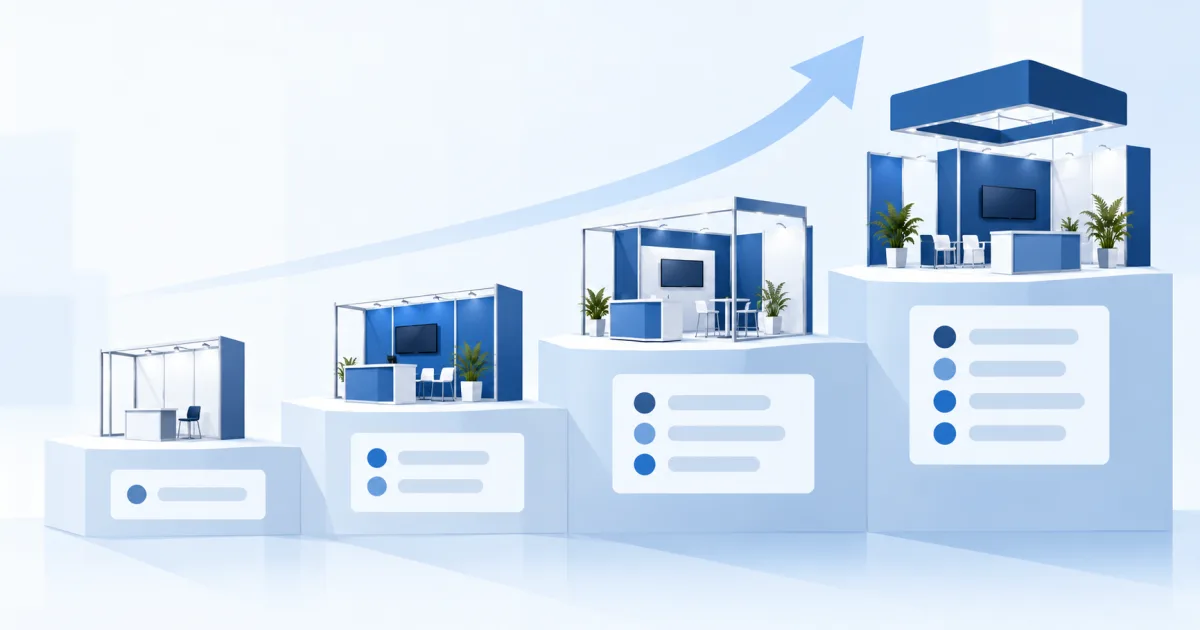
If your platform gives you control over exhibitor-facing pricing, a few approaches are common. Flat per-booth pricing is the simplest to communicate and the easiest for exhibitors to budget around. Tiered pricing by booth size or sponsorship level lets larger exhibitors, who typically capture more leads and get more value from the tool, pay proportionally more. Bundling lead retrieval into a premium exhibitor package, alongside things like priority booth placement or extra badge allotments, is a common way to make the feature feel like part of a value package rather than an additional line item exhibitors have to separately approve.
Whatever pricing model you choose, benchmarking against what your market's A/V vendors typically charge for scanner rentals gives you a useful reference point. If your platform pricing lands meaningfully below the A/V rental rate exhibitors are used to paying elsewhere, that gap is worth highlighting directly in your exhibitor prospectus, since it is one of the more concrete, quantifiable reasons to exhibit at your show over a competing one.
Running Exhibitor Lead Retrieval with VenueSight
VenueSight includes native lead retrieval as part of the same platform organizers already use for registration and badging. Exhibitors scan attendee badges, already issued through the same system used for check-in, with real-time export to their CRM, qualification tags added at the point of capture, and pricing the organizer controls directly. There is no separate app for exhibitors to install and no separate vendor relationship for your team to manage during show week.
For organizers who run a different registration platform but still want to offer and monetize lead retrieval as its own product, Leads by VenueSight is available as a standalone option that plugs into an existing badge format via a CSV roster export, no migration or contract change on the existing platform.
See the exhibitor lead retrieval solutions page for a closer look at how scanning, real-time export, and organizer-controlled pricing work in practice, or compare methods directly in our guide to lead retrieval versus badge scanning if you are still deciding whether your event needs one, the other, or both.
Frequently Asked Questions
Exhibitor lead retrieval software lets exhibitors scan attendee badges at their booth to capture contact information, usually with real-time export to their CRM and the ability to tag leads by interest level at the point of capture.
Built-in lead retrieval uses the same badges and system already running an event's registration, with no separate vendor or app. A standalone app is a dedicated third-party tool that plugs into whatever registration system is already in use, usually via QR, barcode, or NFC, and represents a separate vendor relationship.
It provides the same basic scanning function but is typically the highest per-exhibitor cost of the three common models, and the rental revenue goes to the A/V vendor rather than to the event organizer.
This depends on the model. Platforms with native lead retrieval typically let the organizer set exhibitor pricing directly, turning it into event revenue. When exhibitors pay a third-party vendor or an A/V contractor directly, that revenue does not flow to the organizer unless a specific revenue-share arrangement exists.
VenueSight's native lead retrieval is built into the same platform organizers already use for registration and badging, with real-time CRM export and exhibitor pricing the organizer sets directly. For organizers running a different registration platform, Leads by VenueSight offers the same model as a standalone add-on that plugs into an existing badge format via CSV export, no migration required.
Tagged with:
lead retrieval
trade shows
event technology
event revenue
exhibitor management