
Exhibitor Lead Retrieval vs. Badge Scanning: Which Should You Use?
Lead retrieval captures booth visitors for exhibitors; badge scanning captures all attendees for organizers. Learn when to use each and how to combine them.
August 27, 2026
Lead retrieval and badge scanning are two different ways to capture attendee contact information at a trade show. Lead retrieval lets exhibitors capture booth visitors in real-time via QR code scanning. Badge scanning gives you a complete attendance record of everyone who entered. Understanding when to use each—and how to combine them—determines how much value exhibitors get from your event and how much revenue you can generate.
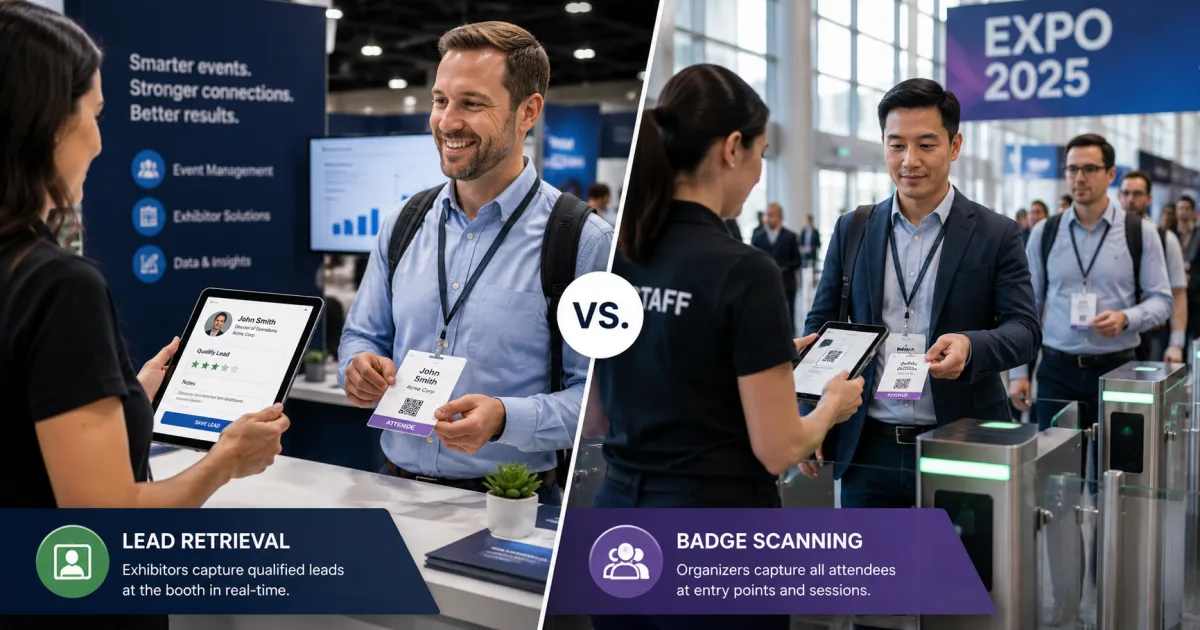
What Lead Retrieval Is
Lead retrieval is a system where exhibitors capture attendee contact information directly at their booth.
- Attendee walks up to an exhibitor booth.
- Exhibitor asks, "Can I scan your badge?"
- Exhibitor scans attendee's badge with an iPad or enters info into a tablet.
- Attendee sees their information and confirms or edits it.
- Exhibitor gets the contact info immediately.
Hardware options:
- Tablet or iPad with mobile app (low-cost, flexible)
- Dedicated scanner guns (fast, but $300–$800 per device)
- Smartphones (zero cost if staff already has them, but slower)
Lead retrieval is real-time for exhibitors: they know immediately who visited and can follow up same-day.
What Badge Scanning Is
Badge scanning is part of your event check-in process. Every attendee who enters your show is scanned at the door.
- Attendee arrives at the show.
- Check-in staff scans their QR code or looks them up.
- System marks them checked in.
- You now have a complete attendance list.
Badge scanning doesn't tell you which exhibits people visited—just that they came.
The Data Difference
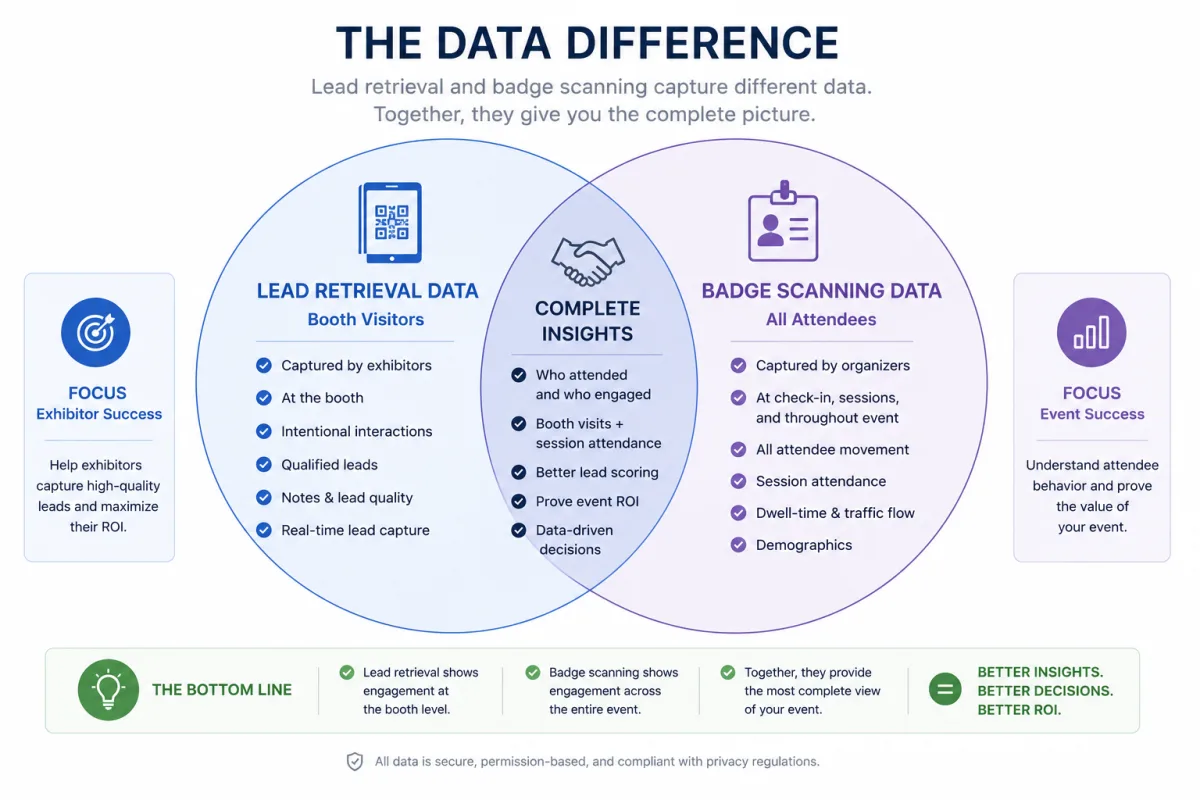
Lead retrieval data:
- Only captures attendees who stopped at a booth
- Tells you which booths they visited
- Real-time for exhibitors
- Voluntary (attendee can decline)
Badge scanning data:
- Captures all attendees who entered
- Does NOT tell you which booths they visited
- Complete coverage
- Mandatory (must check in to enter)
For a 5,000-person trade show:
- Lead retrieval might capture 2,000 leads (40% visited a booth)
- Badge scanning captures all 5,000 attendees
Neither is "better"—they answer different questions.
Exhibitor Perspective
Most exhibitors prefer lead retrieval because it gives them real-time intelligence.
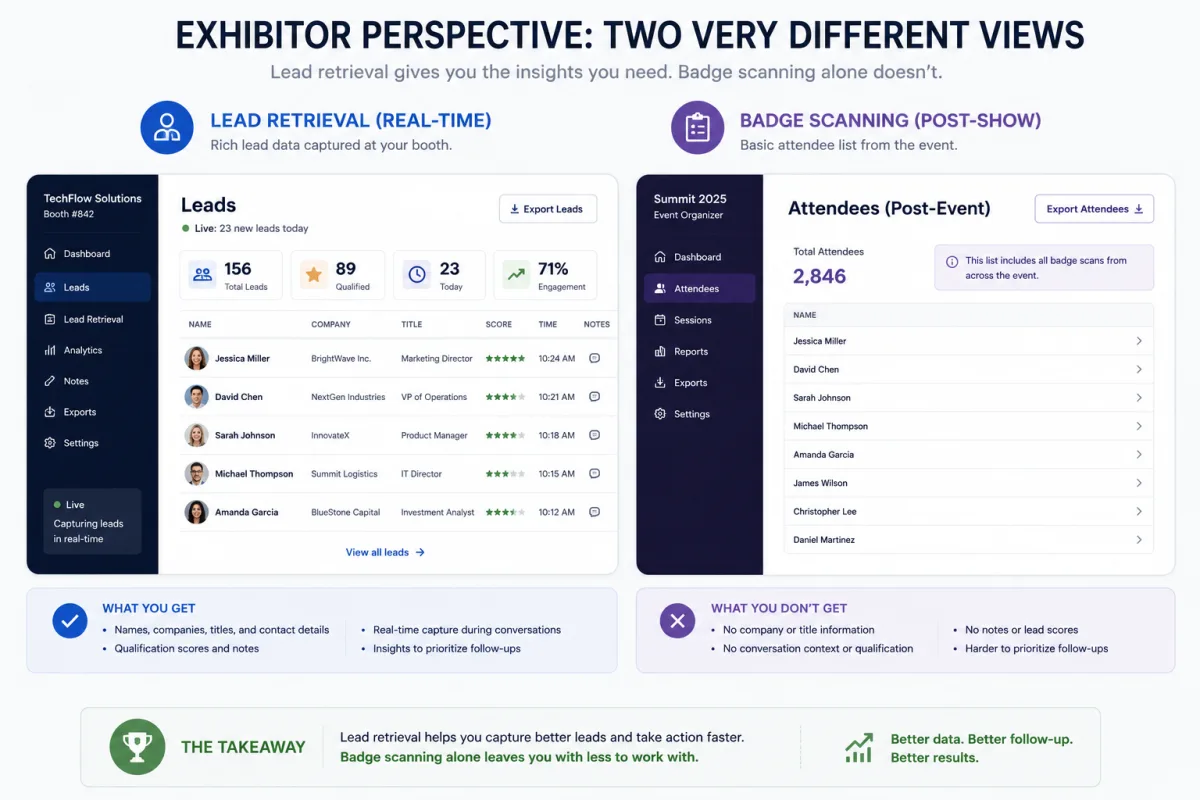
Exhibitor value from lead retrieval:
- Immediate contact info for anyone who engaged
- Can follow up same-day while attendee remembers
- Data goes directly to their CRM
- ROI is tangible: X leads, Y converted
Exhibitor value from badge scanning:
- Post-show list of all attendees
- Less engaged than lead retrieval
- Requires more work from exhibitor to filter
- Useful as secondary option
Exhibitors will happily use lead retrieval. They see it as a tool to maximize ROI. For a comprehensive exhibitor success strategy, read the exhibitor success playbook.
Organizer Revenue Opportunity
This is where most organizers miss money. See the lead retrieval ROI guide for detailed revenue calculations.
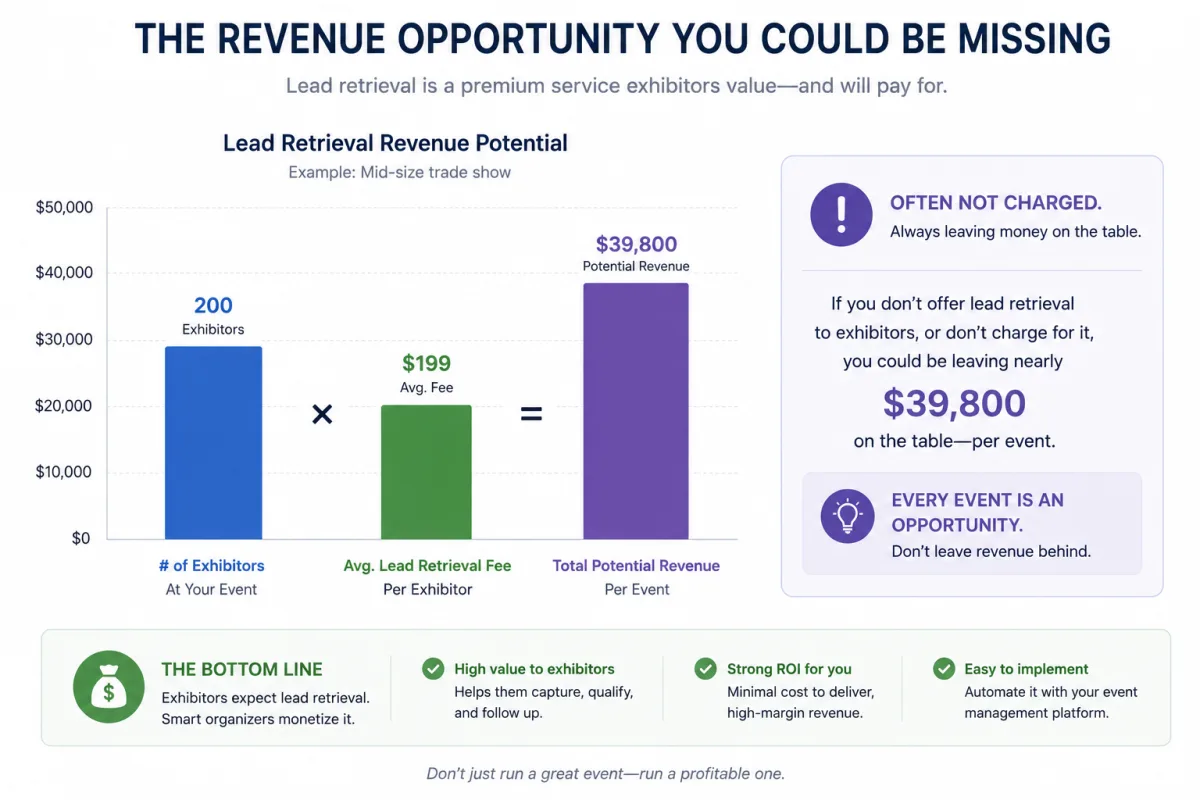
Lead retrieval as revenue:
- Exhibitors pay for lead retrieval hardware ($99–$299 per booth)
- 200 exhibitors × $199 = $39,800 in new revenue
- Pure margin (minimal cost)
Badge scanning data as revenue:
- Sell attendee lists to exhibitors without lead retrieval
- $500–$2,000 per list or per segment
- 10 exhibitors buying lists = $5,000–$20,000
Most organizers don't charge for either. They're leaving significant revenue on the table.
Data Accuracy Tradeoffs
Lead retrieval accuracy:
Badge Printing
Print badges from the registration data you already have
Design badges once, then print them in bulk before the show, at check-in, or let attendees print their own.
- Depends on exhibitors actually scanning (if they forget, data quality drops)
- Attendees might provide fake info
- High-intent data (person was interested), but potentially incomplete
Badge scanning accuracy:
- Highly accurate for "who attended"
- Data from your registration system
- Verified at check-in
- Complete coverage
Session scanning bonus:
- QR code scanning at session entrances
- Tells you which content was popular
- Gives richer data than door-only badge scanning
For maximum insight, use both: badge scanning for complete coverage, lead retrieval for exhibitor engagement.
Privacy and GDPR Considerations
Both methods involve capturing personal data.
Lead retrieval privacy:
- Attendee must consent at the booth
- Exhibitor explains data use ("I'll follow up with you")
- Attendee can see and correct info
- Lower friction (immediate, real context)
Badge scanning privacy:
- Attendee consents when they register
- Pre-disclosed in registration terms
- No in-the-moment consent needed
- Higher friction to object (would require opting out)
Best practice: Clearly state in registration that badge data may be shared with exhibitors. At check-in, if someone objects, offer a private badge.
For lead retrieval, display privacy notice at booths and train exhibitors.
Technical Requirements
Lead retrieval setup:
- Mobile app on iPad or smartphone
- Offline mode (for WiFi drops)
- Attendee data synced from registration
- Integration with exhibitor CRM (optional)
Badge scanning setup:
- QR codes on tickets or badges
- Scanner devices or mobile app at check-in
- Real-time sync to event database
- Offline mode
Session scanning setup:
- QR codes at session entrances
- Mobile devices to scan
- Session attendance data to database
All standard features of modern event platforms.
Which to Use and When
Use lead retrieval if:
- Exhibitors are paying (they want real-time lead capture)
- It's a trade show or B2B conference
- You can charge for lead retrieval ($99–$299 per booth)
Use badge scanning if:
- You want complete attendance data
- You want to sell attendee lists post-show
- Consumer or non-B2B event
- You want session attendance data
Use both if:
- Large trade show with exhibitor engagement + complete analytics
- Want to charge exhibitors for lead retrieval AND sell lists to others
- Want to track session attendance alongside booth visits
Use neither if:
- Small, intimate event (under 20 people)
- Major privacy concerns
- No infrastructure for data delivery
Running Lead Retrieval with VenueSight
VenueSight's lead retrieval integrates directly into the platform.
Organizer workflow:
- Add exhibitors and assign booths
- Enable lead retrieval and configure data fields
- Create unique QR codes for each exhibitor
- Exhibitors download the app on iPad or phone
- They scan attendee badges and confirm info
- Lead data syncs in real-time
- Exhibitors access leads immediately and download to CRM
Exhibitor workflow:
- Open app, sign in with booth code
- Tap "Scan" and scan attendee QR codes
- Confirm attendee info
- Data is saved and synced
- Access leads in dashboard, download to CSV or Salesforce
VenueSight also integrates badge scanning, so you get attendance data in one system. Cross-reference which attendees visited which booths.
Frequently Asked Questions
-
Yes. VenueSight integrates lead retrieval for exhibitors with badge scanning for organizers in a single system, so organizers get full attendance data while exhibitors get their own booth-level lead capture, and the two data sets can be cross-referenced, for example to see which attendees visited which booths.
-
Yes. VenueSight lets organizers set their own lead retrieval pricing and sell it directly to exhibitors as part of the platform, turning what many shows currently give away or outsource to an A/V vendor into organizer revenue instead.
-
Yes. Because VenueSight runs lead retrieval and badge scanning on the same platform, organizers can cross-reference booth visit data against overall attendance, for example seeing which attendees visited a given booth or which sessions an exhibitor's leads came from.