
How to Plan a Conference: A Complete Step-by-Step Guide
Planning a conference involves more than booking a venue and sending invites. This guide walks through every phase — from goal-setting and budgeting through registration, programming, onsite operations, and post-event wrap-up — with the detail experienced organizers actually need.
May 12, 2026
Planning a conference well requires making hundreds of interdependent decisions in the right order. Get the sequence wrong — price registration before you've locked your venue costs, book speakers before you've confirmed your format, open sales before you've built your marketing list — and you spend months undoing early choices that locked you into the wrong direction. This guide covers the full lifecycle of conference planning: from initial concept through post-event wrap-up, in the order decisions actually need to be made.
Start With the Foundation, Not the Logistics
Most conference planning mistakes are made in the first two weeks, when teams jump to logistics before locking the foundation. Before you book a venue or build a registration form, you need clear answers to four questions.
What is this conference trying to accomplish?
Be specific. "A great networking event" is not a goal. "Sign 150 mid-level practitioners who will return next year and engage with our sponsors" is a goal. The answer determines your format, your pricing, your speaker tier, and your marketing strategy. Every decision you make later traces back to this.
Common conference goals and how they shape planning:
- Revenue generation: Prioritizes registration pricing, sponsorship sales, and exhibit hall development
- Community building: Prioritizes networking design, session interactivity, and return attendee experience
- Lead generation (for a company's sales team): Prioritizes audience targeting, sponsor activation, and content quality
- Certification or continuing education: Prioritizes session accreditation, speaker credentials, and attendance tracking
- Thought leadership: Prioritizes speaker quality, content originality, and media coverage
Most conferences serve more than one goal. Rank them. When you're forced to trade off — and you will be — the ranking tells you what to protect.
Who is your audience and what do they need?
Define your ideal attendee with precision: job title, industry, experience level, geography, and what they're trying to solve by attending. The answers shape every content and marketing decision downstream.
Ask: What would make this person cancel a trip to come to your conference? What would make them bring a colleague next year? If you don't know, your content and networking design will miss.
What format serves that audience?
Single-track or multi-track? Keynotes with breakout sessions or workshop-heavy? Exhibit hall or intimate peer exchange? In-person only, or hybrid with a virtual component? The right answer depends on your audience, not your preference.
Multi-track programs serve large, heterogeneous audiences where different roles want different depth. Single-track programs create shared context and stronger community cohesion — better for smaller, tighter-knit audiences. Hybrid adds significant operational complexity; don't add it unless your audience genuinely needs it and you have the budget and platform to do it well.
What does success look like, measured numerically?
Before you spend a dollar, define: How many attendees is the break-even number? What's the target? What NPS or satisfaction score defines a successful event? What sponsor revenue is required for the budget to work? What retention rate year-over-year would prove the conference is working?
Set these numbers before you start so you can measure against them honestly afterward.
Build a Realistic Budget Framework
Build your budget before you commit to a venue or any vendor. It sounds obvious, but many organizers reverse this: they fall in love with a venue, sign a contract, and then try to make the math work.

Revenue sources
List every revenue line with realistic estimates:
- Registration: Estimate conservatively. If you've run this event before, use prior year actuals as the starting point. If it's a new event, research comparable events and assume you'll undershoot by 20–30% in year one.
- Sponsorship and exhibitor fees: What can you realistically sell? Start with conversations with likely sponsors before publishing your prospectus.
- Other income: Workshop fees, pre-conference dinners, recordings or content licensing, app advertising.
Fixed and variable costs
Fixed costs are the same regardless of attendance: venue rental, AV production, speaker fees, insurance, event management software, marketing spend.
Variable costs scale with attendees: badge printing, meals and F&B (often the largest line item), swag, printed materials, event app licenses tied to seat count.
Understanding which costs are fixed vs. variable determines your break-even threshold and tells you how sensitive your budget is to attendance fluctuation.
Budget planning benchmarks
For a professionally produced conference:
- Venue and F&B: 25–40% of total budget
- AV and production: 10–20%
- Marketing: 10–15%
- Speakers and content: 5–15% (highly variable based on whether you pay speaker fees)
- Staffing: 5–10%
- Event technology: 3–8%
- Contingency: 10–15% (non-negotiable; things go wrong)
If your numbers don't balance before you start spending, they won't balance afterward. Adjust scope before committing, not after.
Choose Your Date and Venue
Date selection
Conference dates affect attendance more than most organizers expect. Avoid:
- Major industry competing events (check your vertical's conference calendar)
- Major holidays and the weeks immediately before and after them
- Summer in industries where professionals take vacation (often July–August)
- Year-end close periods for finance-heavy industries (late November, December)
- School calendars if your attendees are likely to have children
Aim for a date at least 6–9 months out for conferences under 500 attendees, and 12–18 months for larger events. The shorter your runway, the harder your marketing problem becomes.
Venue selection criteria
The right venue is the one that matches your format, your audience size, and your budget — not the most impressive one you can afford.

Space requirements: Map your program format to room requirements. A 400-person conference with three concurrent breakout tracks needs a ballroom for general sessions plus three breakout rooms for simultaneous sessions. Walk the venue layout with your program schedule in your hand.
AV and production: Does the venue provide AV in-house, or will you bring your own crew? In-house is often more expensive per item but reduces coordination complexity. Understand exactly what's included in the room rental fee vs. what's an add-on.
F&B minimums: Most hotel conference spaces require a minimum food and beverage spend. Understand this number before you sign. F&B minimums are often non-negotiable and will define your per-attendee cost.
WiFi: Shared hotel WiFi fails at conferences. You typically need a dedicated network with a bandwidth guarantee. Get this in writing in the contract, including the number of simultaneous connections supported and the escalation process if performance falls below spec.
Accessibility: ADA compliance is a legal minimum. Go beyond minimum: evaluate whether the space is genuinely navigable for attendees with mobility limitations, and whether it accommodates dietary and sensory needs.
Hotel room block: For multi-day events, negotiate a room block at the conference hotel. A block gives your attendees a discounted rate and gives you leverage (hotels price conference space based partly on room block commitments). Build in an attrition clause you can realistically meet.
Develop Your Programming and Speaker Strategy
Programming is the product. A conference with weak content will not retain attendees regardless of how well you execute the operations.
Define your content pillars
Your conference should cover a small number of core themes, not everything tangentially related to your industry. Three to five content pillars give attendees a clear reason to attend and make it easier to recruit relevant speakers.
Example: A conference for healthcare administrators might organize programming around: Clinical Operations, Technology & Integration, Compliance & Policy, and Workforce Development. Every session fits into one of these buckets.
Recruit speakers strategically
Work backwards from your audience. What are they struggling with right now? Who in your industry has solved that problem at scale and can speak about it with credibility? Prioritize speaker quality and relevance over speaker fame.
Keynote speakers (high-profile, drawing power) serve a different function than breakout speakers (deep expertise, practical content). You need both. Allocating most of your speaker budget to one marquee keynote at the expense of breakout quality is a common mistake; attendees spend most of their time in breakouts.
Build a call for proposals process
For mid-size and larger conferences, a call for proposals (CFP) surfaces speakers you wouldn't have found by invitation alone. A well-designed CFP:
- Has a clear submission window (typically 6–8 weeks)
- Asks for session title, abstract, format, and learning objectives
- Includes the speaker's bio and a link to prior speaking footage
- Specifies what speakers are (and aren't) compensated for
Review submissions against your content pillars and your audience's known needs. Don't accept sessions that are thinly veiled product demos — attendees notice and it damages trust in your curation.
Session formats
Mix session formats to maintain energy across the day:
- Keynote: 30–60 minutes, plenary, inspirational or big-picture
- Breakout: 45–60 minutes, topic-specific, deeper content
- Panel: 45–60 minutes with 3–4 panelists and a moderator; best for topics where multiple perspectives add value
- Workshop: 90 minutes to 3 hours, hands-on, smaller rooms, limited capacity
- Lightning talks: 10–15 minutes each, useful for showcasing a variety of voices and perspectives
Budget enough transition time between sessions (15 minutes minimum) and include meaningful networking breaks rather than rushing every break.
Set Up Registration Correctly the First Time
Registration is the first experience your attendees have with your organization. A clunky or confusing registration process undermines confidence before the event starts.
Ticket tiers and pricing
Structure your pricing to serve different audience segments and incentivize early commitment:
- Early bird: Discounted rate for registrations through a defined deadline. Creates urgency and helps you forecast attendance early. See the early bird pricing strategy guide for how to set discount levels and timing.
- General: Standard rate after early bird closes
- Group: Discounted rate for 5+ registrations from the same organization
- Member vs. non-member: For association conferences
- Speaker/staff: Complimentary or discounted registration for your team and speakers
- One-day or single-session: If your format supports it
Price based on value delivered, not just cost coverage. Underpricing your conference signals low quality. Overpricing it creates a barrier to first-time attendees who haven't experienced the value yet. Review peer events in your vertical and price competitively within that range.
Registration form design
Collect what you need to operate the event — not everything you wish you knew about your attendees. Every additional required field decreases conversion.
Essential fields: name, email, organization, job title, ticket type.
Conditional fields: dietary restrictions (for events with meals), accessibility requirements, session selections (if limited capacity), t-shirt size (if applicable), badge name (if different from legal name).
Keep optional fields truly optional and explain why you're asking for any unusual data.
Confirmation and communication
Confirmation emails should arrive immediately and include: confirmation number, event dates and location, hotel room block link (if applicable), and a clear statement of next steps. A registration confirmation that just says "you're registered" without practical information creates unnecessary follow-up inquiries.
Download the free 12-Month Conference Planning Checklist
9 planning phases, 70+ action items — from venue selection through post-event closeout. Formatted as a PDF your team can check off together.
Free. No spam. We'll follow up only if you want a demo.
Build a communication timeline: registration confirmation, agenda announcement, hotel deadline reminder, pre-event logistics email (2 weeks out), day-before reminder.
For more on registration setup, VenueSight's event registration solution page covers how to configure tier pricing, discount codes, group registration, and custom fields without IT involvement.
Build Your Marketing Timeline
Marketing a conference is a sustained campaign, not a series of announcements. Most conferences that underperform on attendance trace the problem to a marketing strategy that started too late or relied too heavily on a single channel.
Audience acquisition channels
- Email list: The highest-converting channel for conference marketing. If you don't have a list, start building one. If your list is stale (no email in 6+ months), re-engage before the conference announcement.
- Content marketing: Blog posts, guides, and resources targeting the keywords your ideal attendee searches. This is a long game — start 6+ months out for the content to have time to rank.
- LinkedIn: Primary social channel for most B2B conference audiences. Personal posts from speakers and organizers consistently outperform company page content.
- Partner and sponsor promotion: Your sponsors and speakers have their own audiences. Build promotional expectations into your agreements.
- Referral: The cheapest acquisition. A referral offer (bring a colleague, both get a discount) turns your registered attendees into a distribution channel.
- Past attendee re-engagement: Return attendees convert at higher rates and lower cost than new prospects. Treat them differently in your marketing.
Key campaign moments
- Save the date: 9–12 months out for annual conferences
- Registration open: With the full lineup not yet announced, early bird pricing creates the incentive to register anyway
- Speaker announcement: Announce keynotes to drive a second registration spike
- Agenda published: Full session schedule drives the decision for fence-sitters
- Early bird deadline: Urgency campaign 2–3 weeks before the deadline closes
- Final push: 4–6 weeks before the event, address the remaining objections of people who haven't registered
Manage Sponsors and Exhibitors
Sponsorship revenue is what makes most conferences financially viable. Building a strong sponsor and exhibitor program requires treating it as a sales process, not an afterthought.
An exhibitor prospectus should be ready before your public registration launch. Sponsors need lead time to get budget approved, and they should ideally be making their commitments while your early bird registration is building momentum.
Structure sponsorship tiers (typically three to four levels) around a core bundle of benefits that scales with investment. Avoid a prospectus that lists 30 a-la-carte options — it creates decision paralysis and slows the sales process.
For detailed guidance on building your sponsor pitch document, see the exhibitor prospectus writing guide.
On the exhibitor management side, centralized portals that let exhibitors manage their own booth details, staff badges, and lead retrieval setup without constant organizer intervention save significant staff time at scale. VenueSight's trade show solution covers how exhibitor portals work in practice.
Plan Onsite Operations Before You Need Them
Onsite planning should start no later than 8–10 weeks before the event. Most organizers leave this too late and spend the final week before the conference in reactive chaos.
Check-in and badge management
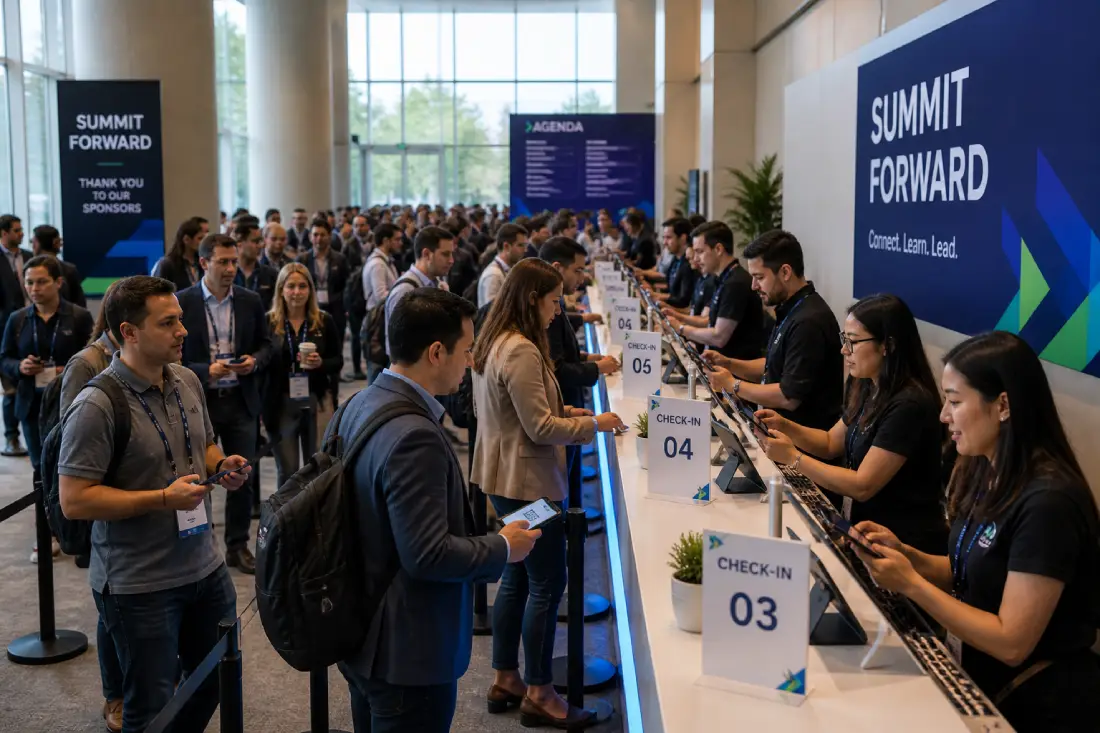
Check-in is the first onsite impression your attendees have. A slow check-in line at 8:00 AM on day one sets a negative tone that's hard to recover from.
Key decisions:
- Pre-print vs. on-demand badges: Pre-printing eliminates the 15–30 second per-badge print time at check-in, but requires accurate data ahead of the event and creates waste for no-shows. On-demand printing accommodates late changes and walk-ins but slows check-in throughput.
- Station count: Calculate based on expected peak arrival volume. 60–70% of your attendees will arrive in the first 45–60 minutes of check-in opening. See the conference check-in guide for the throughput math.
- Exception handling: Name changes, will-call, walk-ins, and staff badges need a dedicated station separate from the main check-in flow.
Session room management
For multi-track programs: How will you control room capacity? How will you handle overflow? Who is responsible for monitoring each room? How are attendance records captured for CEU/certification tracking?
Staff and volunteer coordination
Define roles, not just headcounts. A staff member without a clear role assignment defaults to standing near the registration desk. Assign specific stations, responsibilities, and escalation contacts for every person working the event.
Brief all staff 24–48 hours before the event opens. A morning-of briefing is insufficient — staff need time to ask questions and get oriented before the pressure starts.
Emergency and contingency planning
Know your venue's emergency protocols. Identify the medical response contact, the fire evacuation routes, and the plan if a keynote speaker cancels within 48 hours. Have a decision tree for weather-related cancellation or delay if your event is in a geography or season where that's plausible.
Execute the Event
The days-of execution phase is where planning pays off — or reveals its gaps. A few principles:
Solve problems quietly. Most attendees never notice issues that get handled quickly. Escalate and resolve behind the scenes; don't broadcast problems over the PA or in the main Slack channel.
Protect the program schedule. Sessions running long create ripple delays across the day. Brief all moderators and speakers on hard stop times and ask them to enforce them. A 5-minute overrun in session one becomes a 25-minute overrun by session five.
Capture attendance data in real time. Manual attendance tracking (paper sign-in sheets, head counts) produces incomplete records. For certification-required sessions, real-time scan-in data is the standard.
Communicate proactively with attendees. If a session room changes, a speaker is delayed, or lunch is running 10 minutes late — tell people before they start looking. A text message or push notification to a conference app takes 60 seconds to send.
Gather feedback while it's fresh. Don't wait for the post-event survey. Short (3–5 question) pulse surveys sent during or immediately after each day produce better response rates and more actionable feedback than a comprehensive survey sent a week later.
Post-Conference Wrap-Up
Wrap-up is where conferences either build on their momentum or let it dissipate.
Post-event attendee communication
Within 24 hours of the event ending: send a thank-you email with links to session recordings (if applicable), a post-event survey, and a teaser for next year's event if you're running one.
Sponsor and exhibitor reporting
Deliver sponsor and exhibitor reports within 5 business days of the event. Include: attendance data, session analytics, lead retrieval exports (for exhibitors using lead capture), booth traffic data if tracked, and a summary of earned media and social mentions. Fast, complete reporting is one of the highest-leverage ways to drive sponsor renewal.
Financial reconciliation
Final budget vs. actuals. Where did you overspend? Where did conservative estimates leave you with surplus? Document the variance by line item so next year's budget starts from reality, not from last year's aspirational numbers.
Attendee and team debrief
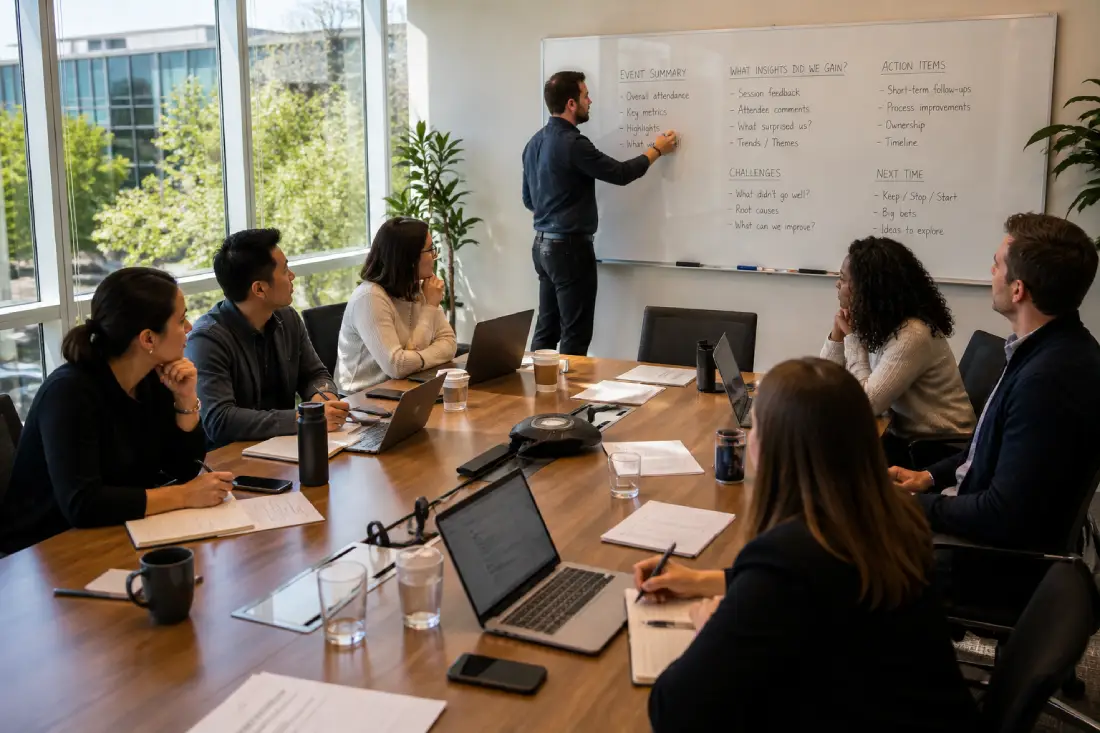
Schedule a structured retrospective within one week while operational details are still clear. Cover: what worked, what failed, what took longer than expected, what was missing. Document decisions made on-site that deviate from the plan — these are the lessons that never make it into the post-event report but determine next year's quality.
Begin next year immediately
The highest-conversion moment for next year's conference is within 72 hours of the current event ending — when attendees are still energized, relationships are fresh, and the value is vivid. Announce the next event date, open super-early bird registration, and give returners a reason to commit now.
Conference Planning Timeline: Month-by-Month Summary
12 months out: Define goals, format, and target audience. Set budget framework. Identify potential dates and begin venue research.
10–11 months out: Select and contract venue. Finalize date. Launch sponsorship outreach. Begin speaker recruitment and CFP process.
8–9 months out: Confirm keynote speakers. Build registration structure and ticket tiers. Launch website with save-the-date. Launch sponsor prospectus publicly.
6–7 months out: Open registration with early bird pricing. Begin email and content marketing campaigns. Review CFP submissions and select breakout speakers.
4–5 months out: Close early bird. Publish agenda. Confirm AV vendor, F&B, and other venue services. Begin staff and volunteer recruitment.
2–3 months out: Open hotel room block. Launch final marketing push. Build onsite operations plan (check-in layout, room assignments, staffing schedule). Send exhibitor portal access.
4–6 weeks out: Final headcount to venue for F&B minimums. Pre-print badges (or finalize on-demand setup). Send pre-event logistics email to all registrants.
1–2 weeks out: Staff briefing. Equipment and supply inventory. Walk the venue. Final check-in system configuration and test.
Event days: Execute. Document issues for debrief.
Within 1 week post-event: Send thank-you email. Deliver sponsor reports. Run team retrospective. Begin financial reconciliation. Tease next year.
Planning Your Conference with VenueSight
VenueSight is built for the full conference lifecycle — not just registration or just check-in, but the entire operational stack from registration open through post-event reporting.
Registration and ticketing: Configure multi-tier pricing, discount codes, group registration, and custom fields without involving a developer. Attendees get an immediate confirmation email; you get a live dashboard of registration volume, revenue, and conversion.
Event check-in: The VenueSight check-in app works on standard iPads and supports both QR code scan and name-search lookup. Badges can be pre-printed in bulk or printed on-demand at the station. For larger events, self-service kiosks let attendees check themselves in and print their own badge in under 30 seconds, reducing staffing requirements at the door.
Session management: Track attendance by session with scan-in at room entry. Reports pull automatically for CEU certification, sponsor deliverables, and content planning for next year.
Exhibitor and sponsor tools: Give exhibitors their own portal to manage staff badges, lead retrieval, and booth details without routing everything through your team. Sponsor reporting exports run automatically when you're ready to send.
Team size that fits: VenueSight is used by single-person planning teams running 200-person association conferences and by operations teams managing 5,000-attendee trade shows. Pricing is based on event size, not per-seat licenses. See the conference solutions page for a full feature overview, or book a demo to see it built around your specific event.
Tagged with:
Related posts
- Conference Planning Timeline: Month-by-Month Checklist for Event Organizers
- Event KPIs Every Organizer Should Track (and How to Actually Measure Them)
- Running a Conference With 10,000+ Attendees: The Software and Operations Checklist
- Trade Show Operations: The Complete Guide to Running a Profitable Show