
Sponsorship Tier Design: How to Build Packages Sponsors Actually Buy
The key to sponsorship revenue is designing tiers that align perceived value with price. This guide covers what sponsors buy and how to structure tiers.
August 4, 2026
Sponsorship tiers are the primary lever event organizers pull to drive revenue from exhibitors. Done well, they create the perception of choice, anchor buyers to a price point, and allow you to extract value from sponsors who would otherwise negotiate you down. Done poorly, they confuse buyers, cannibalize each other, and leave money on the table.
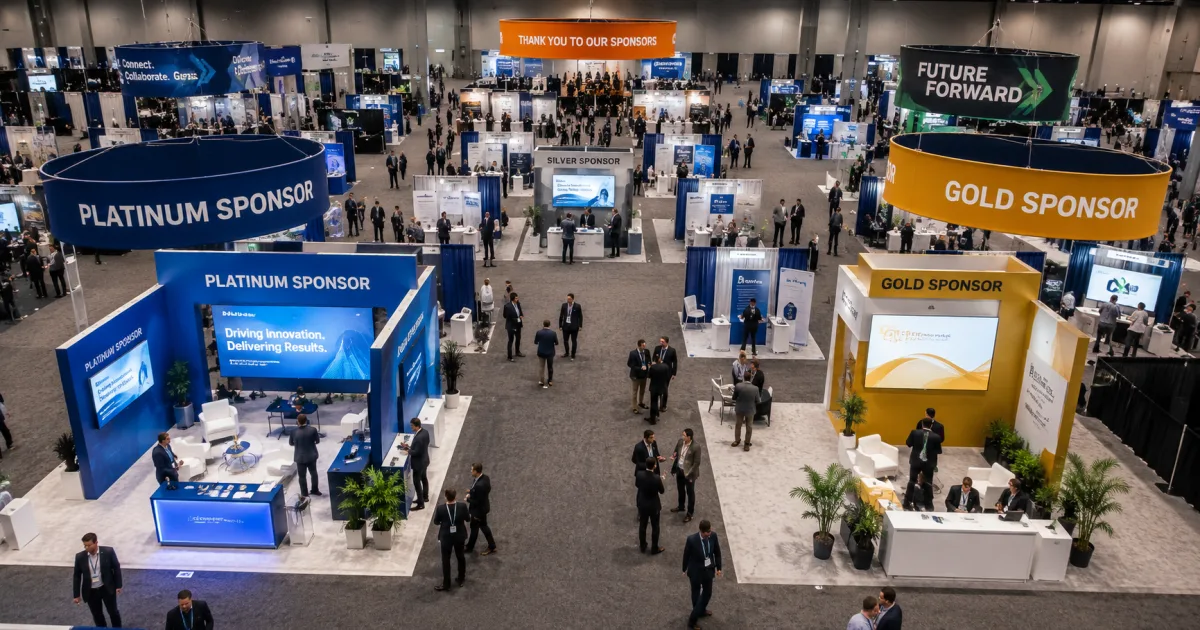
The difference is understanding what sponsorship tiers actually are: a mechanism for price discrimination and value perception, not a feature list. This guide walks through how effective trade show and conference teams structure, price, and refine their sponsorship packages.
The Real Purpose of Sponsorship Tiers
Most event organizers think of sponsorship tiers as a way to communicate what sponsors get. That's backwards. Tiers exist because some sponsors will pay $10,000 and some will pay $30,000, and without tiers, everyone negotiates you down to the lowest acceptable price.
Tiers solve this by creating the illusion of structure and inevitability. A sponsor sees "Gold at $25,000" and "Platinum at $40,000," and instead of asking "can you do $18,000?" they ask "which tier fits our budget?" This is price discrimination: selling the same core value (booth space, audience access, logo visibility) to different buyers at different prices, justified by tier benefits.
The second purpose of tiers is perceived value. A sponsor doesn't compare your sponsorship to your cost; they compare it to what they're getting for the dollar. A $25,000 package that includes "5 featured social media posts" feels better than one that doesn't, even if social posts add nothing to their ROI. This doesn't mean padding with useless benefits—it means bundling and naming benefits in ways that make them feel substantial.
The third purpose is operational. Tiers prevent infinite negotiations. When a sponsor asks "what if we added a speaking slot?" you can say "that's in our Premium tier" or "that's a $5,000 add-on," rather than going back and forth on custom proposals.
What Sponsors Actually Buy
Before you design tiers, understand what exhibitors are actually trying to accomplish. They come to your event to:
- Reach your audience — generate leads, build brand awareness, or establish thought leadership in front of specific attendees
- Gather competitive intelligence — see what other vendors are doing, find partnership opportunities
- Close deals — talk to hot leads, move existing prospects past objections
- Build relationships — spend time with existing customers or prospects in a casual setting
- Generate content — use booth interactions, speaking slots, or event footage for marketing
Sponsorship benefits should ladder to these goals. A speaking slot appeals to someone trying to build thought leadership. Dedicated lead retrieval support appeals to someone focused on closing. A private lunch appeals to someone trying to deepen existing relationships.
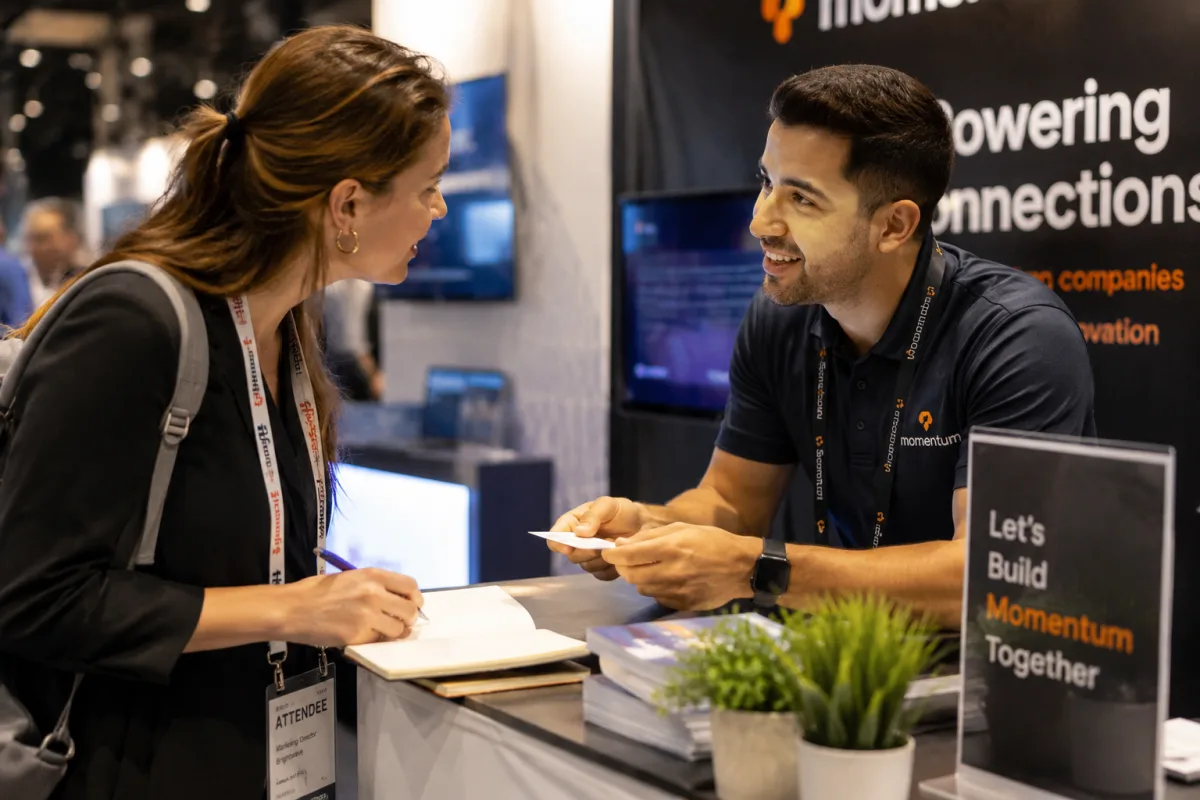
Ask your sponsors directly: "What business outcome are you trying to achieve at this event?" Their answer determines which tier benefits actually matter to them.
Understanding sponsor motivations also connects to your broader sponsorship sales strategy, which covers how to position sponsorship packages to different prospect types and move deals through your sales pipeline.
Benefits That Sell vs. Benefits That Look Good
Here's what doesn't move sponsors: unlimited marketing mentions, extra booth furniture, parking passes, complimentary registrations for their staff, and "dedicated account support" (unless you actually staff an account manager).
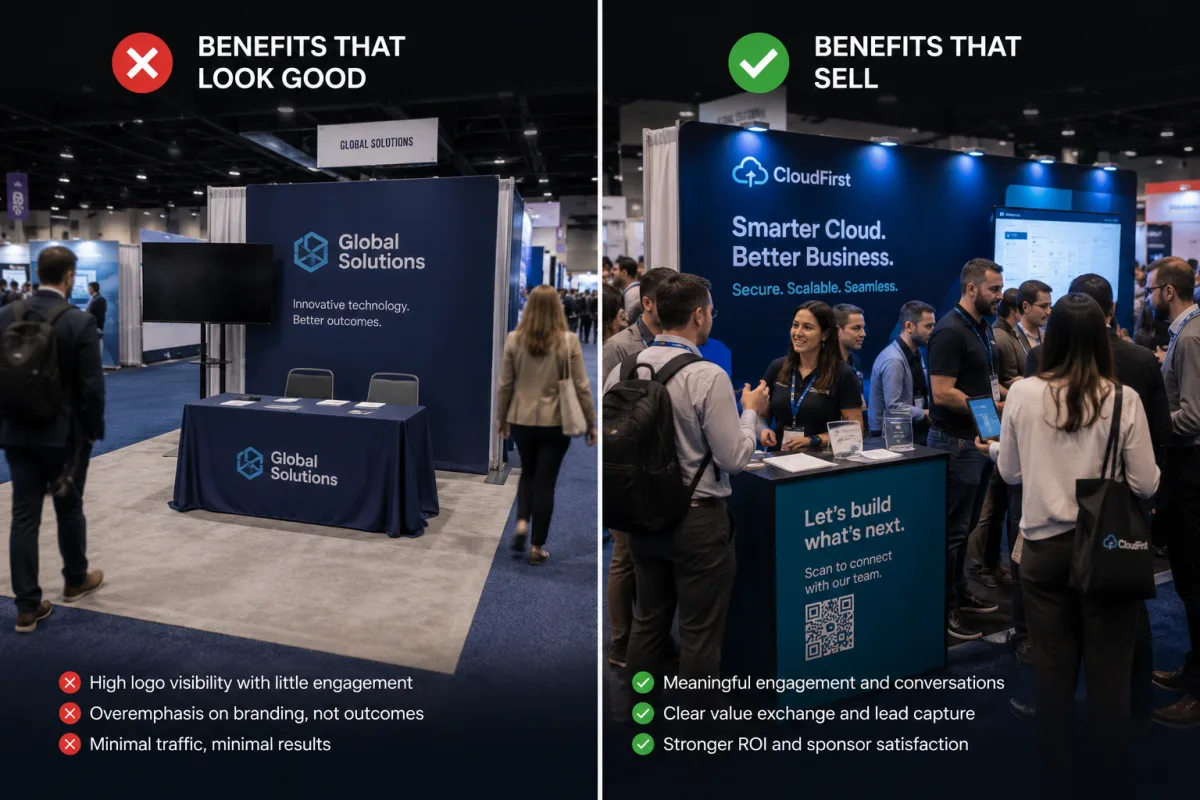
Here's what it does: audience access, exclusivity, lead data, speaking opportunities, logo visibility in high-traffic contexts, private event hosting, and direct access to you or other exhibitors.
The distinction is simple: if a benefit helps the sponsor reach the audience or close business, it sells. If it's administrative overhead or generic corporate perks, it doesn't.
Benefits that actually sell:
- Speaking or panel opportunity (keynote, breakout session, roundtable)
- Booth location (premium vs. standard vs. corner)
- Lead retrieval technology with defined attendee data points (attendee contact, company, title, interests)
- Logo visibility on stage (if visible during keynote or closing), event signage (if foot traffic is high), or sponsor badges
- Private hospitality space (reception, lounge access, private lunch with organizers)
- Ad space on the event app
- Exclusive category sponsorship (no competing vendors in the same tier)
- Access to attendee list (pre- or post-event)
- Speaking time (minutes of stage time during the event)
- Sponsored session (ability to run a breakout or workshop)
Benefits that don't move the needle:
- Parking passes
- Hotel room blocks
- Complimentary registrations for their employees (they won't use them)
- Unlimited social media mentions (they don't convert leads)
- "Premium networking event" (you can't guarantee who shows up)
- Branded materials in swag bags (most are trashed)
- Mentions in email to attendees (poor visibility, doesn't drive behavior)
Test this in your next event: after the show, ask sponsors which benefits they used and which they valued. Most will say "the lead data" or "the speaking slot" and be vague about the rest. This feedback is critical for the next event cycle. Our guide on post-show reporting and sponsor retention covers how to gather and use this data to inform tier refinement.
Defining Tier Levels: What Goes in Each Package
A tier is a bundle of benefits at a fixed price. The bundles should feel qualitatively different, not just quantitatively different. A $20,000 tier should not be "everything the $15,000 tier has plus one extra thing"—it should be a step up in audience access or exclusivity.
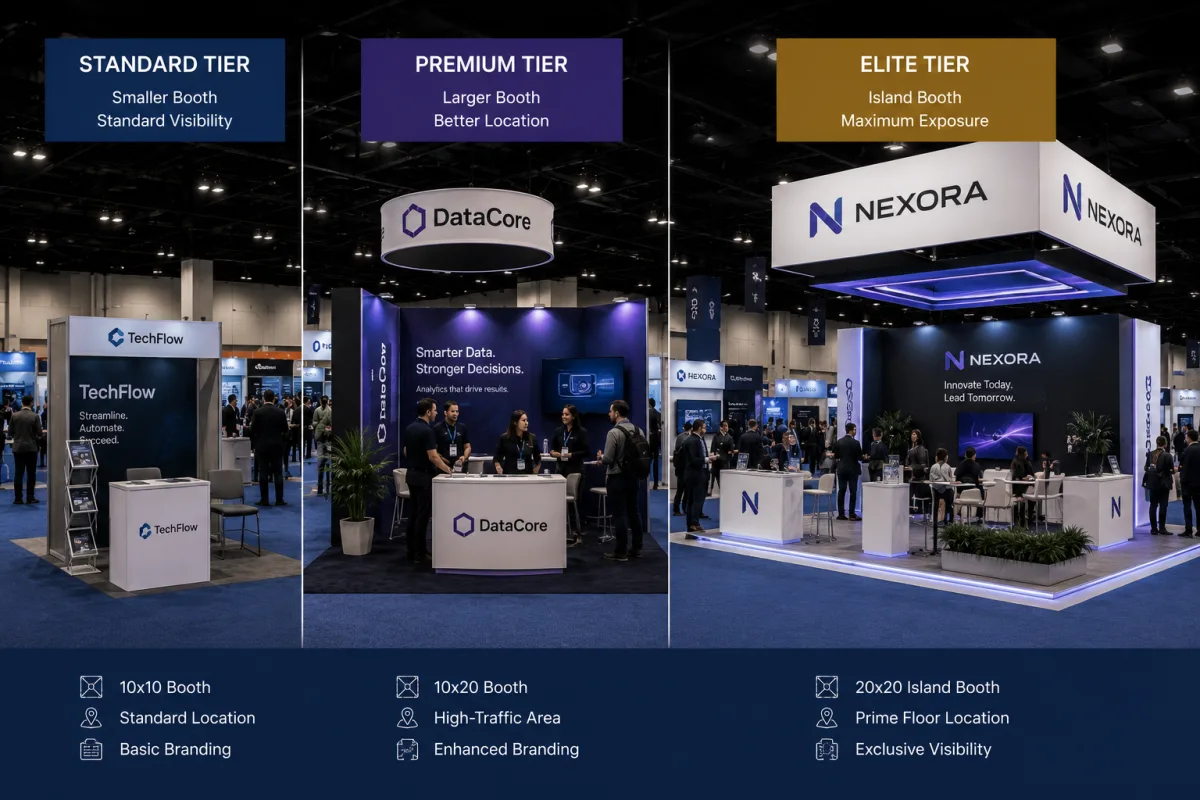
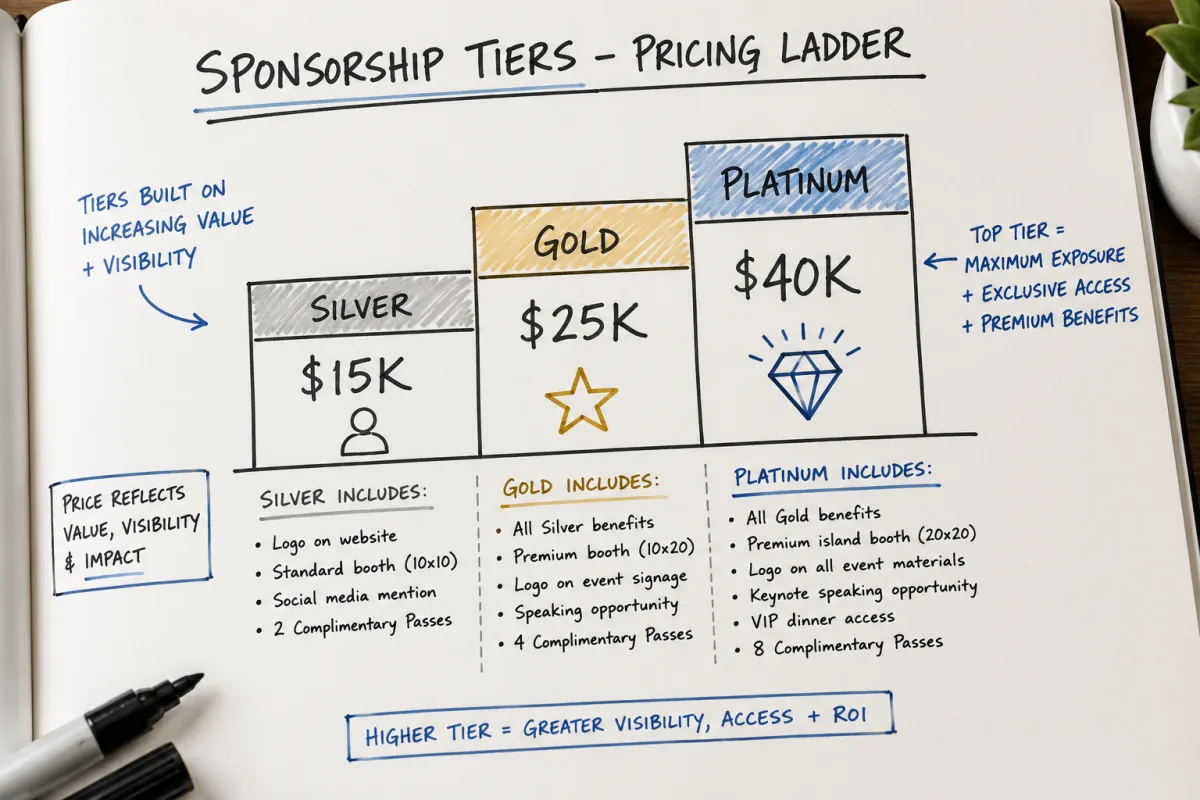
Typical structure (for a 200-booth trade show):
Silver: $15,000 (entry-level)
- 1 standard booth (10x10 ft)
- Attendee lead data (name, company, title, email from badge scans)
- 1 complimentary registrations for booth staff
- Logo on event signage
- 2 social media mentions
Gold: $25,000 (mid-tier, 60% of sponsors buy this)
- 1 standard booth (10x10 ft) or 1 corner booth (premium location)
- Attendee lead data with custom demographic filters
- 2 complimentary registrations
- Logo on event signage and sponsor badges
- Speaking opportunity (1 breakout session slot)
- Private sponsor reception (evening before show)
- 4 social media mentions
Platinum: $40,000 (premium, high-value)
- 1 premium booth (10x20 ft island or corner)
- Attendee lead data with demographic, psychographic, and intent filters
- 3 complimentary registrations
- Logo on all signage, sponsor badges, and event app
- Exclusive category sponsorship (no competing vendors)
- Speaking opportunity (keynote or 2 breakout slots)
- Sponsored breakout session (organizer runs it; sponsor co-leads)
- Private sponsor reception
- Pre-event attendee list
- 6 social media mentions
Notice: Silver to Gold is a step up in exclusivity and data. Gold to Platinum adds audience access (speaking, pre-event list, co-running a session).
Choosing a Naming Convention
Most trade shows use precious metals (Silver/Gold/Platinum), colors (Bronze/Silver/Gold), or industry-specific names. Which you choose matters less than consistency and clarity.
Metals (Silver/Gold/Platinum) work because:
- Attendees immediately understand the hierarchy
- It's neutral—doesn't imply your industry or company values
- It's flexible—you can add Diamond or Silver+ if you change your tier count
Avoid:
- Sponsor-centric names (Partner/Enterprise Partner/Premier Partner) — these are vague
- Cutesy names (Unicorn/Dragon/Wizard) — they confuse buyers and don't scale
- Numbers (Tier 1/2/3) — less memorable and less prestigious-feeling
- Generic jargon (Essential/Standard/Premium) — overused and forgettable
Pick a naming scheme and stick with it across years. Sponsors expect consistency.
Pricing Your Tiers: Cost-Plus vs. Value-Based
Two approaches:
Cost-Plus: Calculate what it costs to deliver each benefit, add markup, and set the price. A 10x10 booth costs you $500 to set up and staff; lead retrieval software costs $2,000; a speaking slot costs nothing. Mark up 3x cost, and your Silver tier is priced at ($500 + $2,000/4 exhibitors + markup) ≈ $8,000.
Value-Based: Estimate what the sponsor will earn in revenue from each benefit, and price accordingly. If a sponsor closes 3 deals worth $50k each from leads generated at your event, your lead retrieval is worth $20-30k. Price accordingly.
Exhibitor Revenue
What could lead retrieval earn your show?
Lead retrieval is built in, so the fees exhibitors pay a third-party vendor today can go to your show instead. See the number for your floor.
Value-based is stronger. If a sponsor will earn $150k in new revenue from exhibiting and converting leads, they'll pay $30-40k for a tier that gives them the tools to do it. If you price based on cost, you'll underprice.
How to estimate value:
- Ask your best sponsors: "What's the ROI you generated from last year's booth?" (Many will share ballpark figures.)
- Survey attendees: "If you made a purchase decision related to a vendor you met at this event, what was the size of that deal?" Average the results.
- Use your lead data: Count how many leads convert to deals; estimate deal size; work backward to see what a lead is worth.
For most trade shows, a lead is worth $100-500 in sponsor revenue (net of close rate, deal size, and margin). A tier that delivers 100 qualified leads is worth $10-50k to the right sponsor.
Price tiers 20-30% apart in entry-level/mid-tier, 40-50% apart in mid/premium. Silver at $15k, Gold at $25k (+67%), Platinum at $40k (+60%) is reasonable tier spacing.
Two Tiers vs. Three vs. Four
Two tiers (Silver and Gold) work if:
- Your event is under 100 booths
- You have limited operational overhead
- Your audience is homogenous (all the same industry/company size)
Two tiers make it easy: small sponsors take Silver, serious sponsors take Gold. But you'll leave money on the table from sponsors who'd pay $30k if it felt like a meaningful step up from $20k.
Three tiers (Silver, Gold, Platinum) work if:
- Your event is 100-500 booths
- You want pricing that captures different budgets without overwhelming choice
- Most of your sponsors are mid-market (not all enterprise, not all small)
Three is the sweet spot for most trade shows. It creates enough tier separation that each tier feels distinct, without creating decision paralysis.
Four tiers (Silver, Gold, Platinum, Diamond) or more work if:
- Your event is 500+ booths
- You have a clear mix of booth sizes/sponsor levels (e.g., global Fortune 500 companies, mid-market vendors, small startups)
- You can operationally support complex sponsorship management
Four tiers can work, but tier #3 and #4 often blur together. Sponsors get confused about the difference between Platinum and Diamond. Avoid unless you have a clear operational reason (e.g., booth size is the differentiator).
Building a Custom/Enterprise Tier
Your biggest sponsors don't buy tiers—they negotiate custom deals. But the custom deal should be structured, not ad-hoc.
Create an informal "Enterprise" or "Custom" tier that you propose to sponsors spending $50k+. The structure might be: "We can build a custom package starting at $50k. Typical components include exclusive category sponsorship, dedicated booth space, speaking opportunities, private events, and pre-event data access. Let's talk about what matters to you."
Then you negotiate based on what they actually want, but within a framework. This prevents "we'll price it at what they ask for" and instead creates a floor.
Document your biggest custom deals after the event. If a sponsor paid $75k for exclusive category sponsorship + 2 speaking slots + private lunch, that's a data point for next year's Platinum tier or the next sponsor in that category.
Testing and Refining Tier Pricing
Your first tier structure is a hypothesis, not gospel. Refine it after each event.
Metrics to track:
- How many sponsors bought each tier? (If 90% buy Gold and 5% buy Silver and Platinum, your tiers are misaligned.)
- Which benefits did each tier use? (If 50% of sponsors never use the speaking slot, move it to Platinum or drop it.)
- How many negotiated down? (If half your prospects negotiate, your pricing is too high or the value story is weak.)
- What was the average deal size? (If your average is $18k but you priced Silver at $15k and Gold at $30k, move prices closer together.)
After the show, send a post-event survey: "Which tier benefits did you use? Which benefits do you wish were in a higher/lower tier? What would have made you upgrade to a higher tier?"
Over two to three events, you'll see patterns. Maybe "dedicated account support" moves from Silver to Gold because sponsors don't value it pre-show but love it during the event. Maybe "speaking opportunity" moves from Gold to Platinum because demand is high and you want to limit who gets it. Maybe you add a fourth tier because you have a bunch of sponsors between your Gold and Platinum prices.
For a complete view of how to optimize sponsor packages across the full event lifecycle—from prospectus design to post-show follow-up—see our resource on exhibitor success management.
Common Mistakes
Too many tiers: Five or more tiers overwhelm sponsors. Stick with 2-3.
Overlapping benefits: Silver includes "logo on signage" and Gold includes "logo on signage and sponsor badges." Sponsors notice the redundancy and feel cheated. Make each tier a clear step up.
Benefit inflation without price increase: If last year's Gold tier had 3 social posts and this year it has 5, but you didn't raise the price, sponsors expect the upgrade. Don't silently add benefits year over year—communicate the value.
Tiers named after tier, not benefit: "Sponsor Level A / Level B / Level C" tells sponsors nothing. "Silver/Gold/Platinum" or "Startup/Growth/Enterprise" tells them where they fit.
No clear differentiator between tiers: If the only difference between Gold and Platinum is 2 extra social posts, sponsors won't upgrade. Differentiate on audience access, exclusivity, or impact (speaking, data, private events).
Underpricing to "fill tiers": If you have half your booth capacity sold and you discount Platinum to move volume, you've devalued your highest tier. Leave it empty before discounting.
Not testing custom deals against tiered pricing: If a sponsor pays $60k for a custom deal that includes most of Platinum, you should fold that into a new standard tier. Don't let custom deals be secret—they're market feedback.
Running Sponsorship Packages with VenueSight
VenueSight lets you define sponsorship tiers in the event setup, then track which sponsors bought which tier throughout the event. This means lead retrieval data, booth assignments, and speaking slots are all tied to the sponsorship package, making it easy to enforce the benefits you promised.
For sponsorship management specifically, you can set up each tier in the exhibitor portal, assign sponsors during registration, and then use the platform's analytics to track which sponsors activated their benefits (lead retrieval, app mentions, etc.). This gives you the data you need to refine tiers for next year's event.
The key is tying tier benefits to operational checkpoints: if a sponsor is Platinum, they automatically get a corner booth (not standard), access to the pre-event attendee list, and a reserved breakout session slot. You're not manually tracking "did we deliver the Platinum package?" because the system is managing it.
Explore how VenueSight handles sponsorship packages at https://venuesight.com/solutions/trade-shows.