Conference Budget Template: A Line-by-Line Breakdown for Event Organizers
Free conference budget template in Excel and CSV: 44 line items with typical costs, plus subtotals, contingency, cost per attendee and break-even ticket price.
June 10, 2026
· Updated November 2, 2026
Conference budgets go wrong in predictable ways. A/V costs 40% more than quoted because of unplanned add-ons. Registration revenue comes in 20% below projection because early bird pricing was set too aggressively. Catering overruns because the minimum guarantee was set assuming 90% attendance and actual attendance was 70%. And the contingency line — if there is one — disappears in month 3.
Free Download
Free conference budget template
44 line items in 11 categories, each with its typical cost range or formula and a column for your estimate.
Subtotals, contingency, cost per attendee and break-even ticket price calculate as you type. Opens in Excel, Google Sheets and Numbers.
A realistic conference budget isn't just a list of expense categories. It's a model: one that accounts for uncertainty early, scales costs to realistic attendance projections, and phases revenue to reflect when money actually lands versus when expenses are due. This guide covers every revenue and expense line item with guidance on how to estimate each one before you have firm numbers.
The Template
Download the conference budget template (CSV) — every line item covered in this guide, organized by category with a blank column for your own numbers, ready to open directly in Excel or Google Sheets.
The template covers:
Revenue: registration, sponsorship & exhibitor, other revenue sources
Attendee Experience: networking events, entertainment, awards program
The contingency line
Formulas and typical dollar ranges for every line item above are covered category by category below — use this section to fill in your own numbers as you read.
Budget Structure: Revenue Before Expenses
Build the revenue side of your budget before committing to expenses. This sounds obvious but is frequently reversed in practice: organizers select a venue, contract catering, and book speakers, and then calculate whether the event can cover those costs.
The right sequence:
Define attendance and revenue targets (realistic, based on prior year or comparable event benchmarks)
Calculate what those targets produce in registration and sponsorship revenue
Determine what total expense the revenue target can support given your margin requirement
Build an expense budget that fits within that ceiling
This approach prevents the most common conference budget failure: building an event around assumed expenses, then realizing partway through planning that the revenue math doesn't work.
Revenue Line Items
Registration revenue
Formula: Projected attendance x blended ticket price
The blended ticket price accounts for early bird, standard, and late pricing tiers and the expected distribution of registrations across those tiers. Model conservatively:
Early bird buyers: typically 20–35% of total registrations (higher for recurring events with an established audience)
Standard rate buyers: 45–60%
Late and on-site: 10–20%
Blended price example: 30% early at $499, 55% standard at $699, 15% late at $849. Weighted average: $659. On 800 registrations, that's $527,200 in gross registration revenue.
Apply an attendance discount factor. Event registration almost universally includes complimentary and discounted categories: speakers, sponsors, exhibitor staff, press, board members, scholarship recipients. On mid-size conferences, comped and heavily discounted tickets typically represent 15–25% of total registrations. Adjust your revenue calculation for the paying attendee percentage.
Sponsorship and exhibitor revenue
This is the category most often modeled optimistically. Apply a pipeline discount factor:
If your sponsorship prospectus is already to market with confirmed prospects, model 60–70% of pipeline as closed
If you're building the prospectus now with no existing sponsor relationships, model 30–40% of pipeline as closed for the first year
Returning sponsor retention rates for recurring events: typically 60–80%, depending on exhibitor satisfaction and show performance
For trade show exhibitor revenue, model the exhibit hall at 75–80% sold rather than 100%. Gaps, last-minute cancellations, and floor plan adjustments typically prevent a fully sold floor.
Other revenue sources
Grant or association funding, registration processing fees (if passed to attendees), networking event tickets (priced separately from conference admission), raffle or charity auction revenue, and virtual add-on ticket revenue for hybrid events are legitimate revenue lines at specific event types.
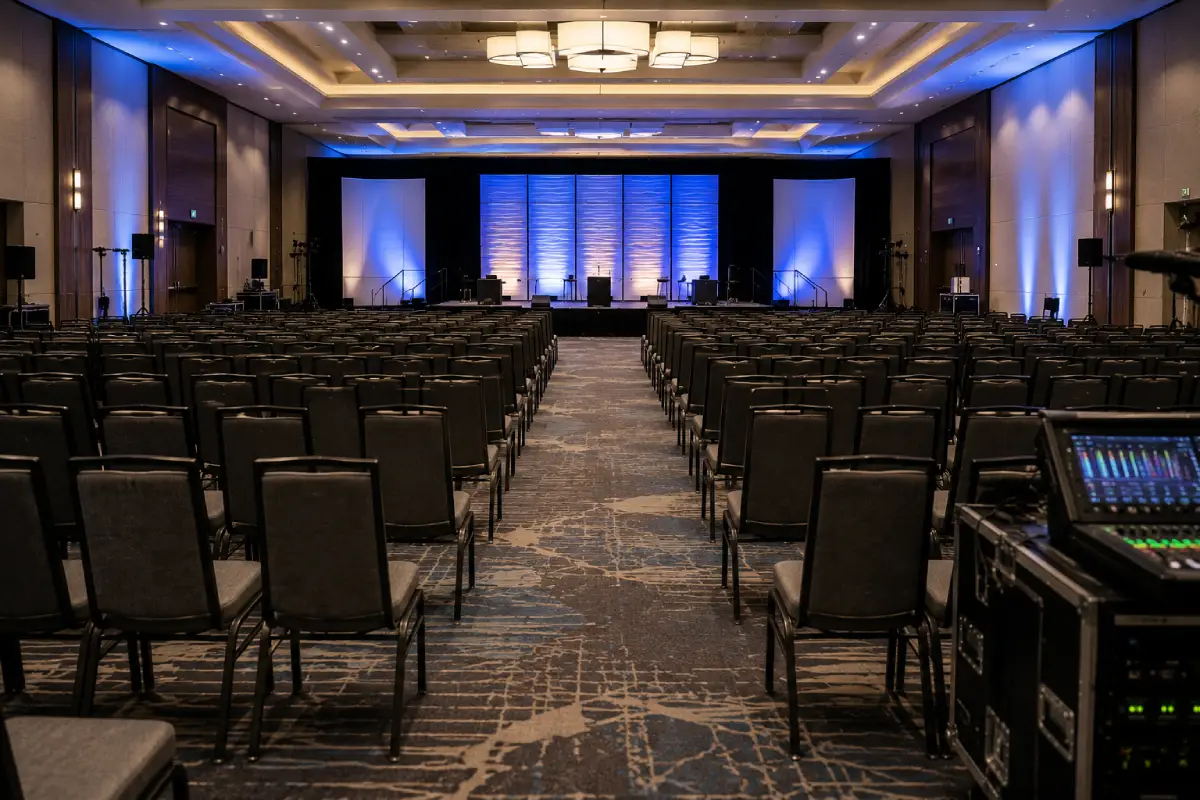
Expense Category: Venue and FacilitiesVenue setup
The venue is typically the largest single expense in a conference budget and the one that most often has hidden costs.
Room rental
Main ballroom or general session space, breakout rooms, pre-function areas, registration area. Many hotels bundle room rental into a food and beverage minimum — you pay zero room rental if you meet the F&B spend, or a room rental fee if you don't. Understand this calculation before comparing hotel vs. convention center pricing.
Estimate: $2,000–$25,000+ per day for a ballroom, depending on market, capacity, and season. Breakout rooms: $500–$2,000 per room per day. Major convention centers in top-10 cities charge significantly more.
Equipment and venue services
Internet/wi-fi (convention centers charge separately — often $5,000–$25,000 for a dedicated bandwidth package for a mid-size conference), electrical service for booth and stage power drops, staging (risers, stairs, podium), union labor for load-in and load-out if required by the venue.
Budget red flag: Wi-fi at a convention center is one of the most consistently underestimated line items. Get a specific quote for the bandwidth level your event requires — not the basic "show" package — before finalizing your venue selection.
Guest room block
If you've negotiated a guest room block, understand your attrition clause: the commitment to fill a percentage of the contracted rooms or pay for unsold rooms. Model your block conservatively and negotiate the attrition rate. 70–75% attrition is common; some venues push for 80–85%. Unsold rooms in the block represent real financial exposure if attendance falls short.
Expense Category: Food and BeverageFood and beverage planning
F&B is typically the second-largest expense category and the one with the most flexibility — and the most hidden charges.
Catering line items
Continental breakfast: $25–$50 per person per day
Lunch: $45–$85 per person per day
AM and PM breaks: $15–30 per person per break
Welcome reception: $45–90 per person (depending on alcohol)
Gala dinner (if applicable): $90–175 per person
Service charges and taxes
All venue catering is subject to a service charge (typically 22–26%) and applicable sales tax. These apply to the base catering price, not just to labor. On a $40,000 catering total, a 25% service charge and 8% tax adds $13,200. If your budget shows $40,000 for F&B and doesn't include service charge and tax, your actual F&B cost is $53,200.
Budget for service charge and tax explicitly. Never use a per-person catering rate without adding the applicable service and tax.
Guarantee vs. actual count
Your catering contract will specify a guarantee — the minimum headcount you're committed to pay for, typically 80–90% of your projected attendance. Set your guarantee at a number you're confident reaching based on registration trends, not your hoped-for number. The difference between a guarantee at 80% vs. 90% of 800 projected attendees is 80 meals — and at $70 per person, that′s $5,600 in guaranteed spend.
Expense Category: Audio/Visual and ProductionAV Production Setup
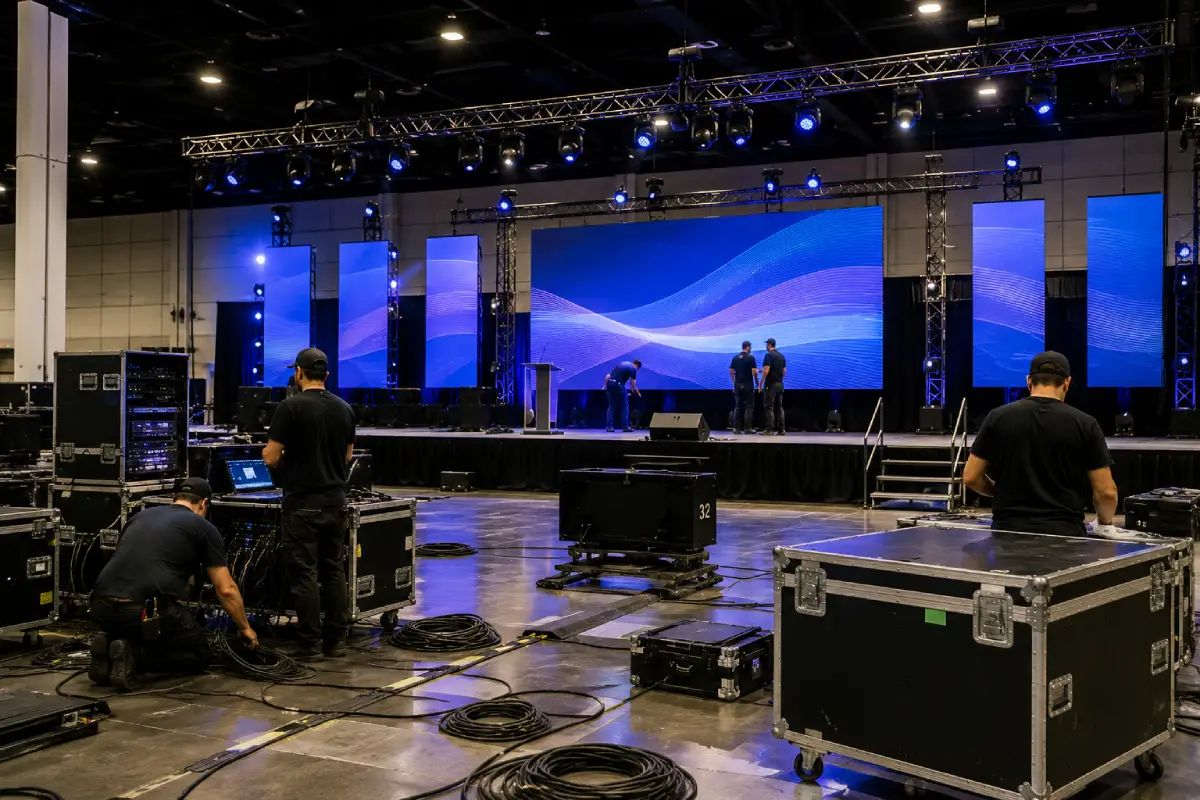
A/V is the expense category most likely to overrun. Quotes change when the final session schedule is more complex than originally scoped, when speakers add last-minute technical requirements, or when the production company is the in-house vendor with captive pricing.
A/V line items
General session A/V: LED screen and projection, stage lighting, PA system, stage monitors, confidence monitors, click-track system, recording equipment
Breakout room A/V: Projector/screen, microphone, speaker system per room (multiply by room count and day count)
Rigging and labor: Union labor for load-in, setup, show operation, and strike. Larger venues require union labor; rates vary by market but $800–2,000 per day per technician is common
Livestreaming or hybrid production: Camera operators, encoding equipment, platform fees, and potentially a remote producer if the hybrid audience has an interactive component
A/V budget approach: Get a detailed quote for your final session schedule with room-by-room breakdowns. Avoid global day rates without line-item support — they make overruns invisible until the final invoice arrives.
Rehearsal and load-in days
A/V charges apply to load-in days and speaker rehearsal days, not just show days. A 2-day conference with a load-in day and rehearsal day has 4 days of A/V labor costs. If your budget only accounts for the 2 show days, your A/V cost is wrong.
Expense Category: Registration and Technology
Registration platform
Subscription or per-registration fees for your event management software. Models vary: some platforms charge a flat annual subscription, some charge a per-ticket fee (typically 1–3% of ticket revenue), some charge a flat per-event fee. Calculate total cost based on your actual projected registrations. For guidance on what to evaluate when selecting a registration platform, see the guide on conference registration best practices.
Badge printing and supplies
Badge stock, lanyards, badge holders, thermal ribbon or inkjet cartridges (depending on badge printer type). For on-demand printing, factor in the time cost of printing during the registration window. For pre-printed badges, factor in reprints for name changes and spelling errors (budget 3–5% waste).
If you're using a mobile event app, annual subscription or per-event licensing fees. Typical range for mid-size events: $3,000–15,000 per event, depending on platform and feature set.
Lead retrieval
If you're providing lead retrieval to exhibitors as an included service (rather than a revenue line), factor in platform costs. If you're charging exhibitors for lead retrieval, it nets against this line.
Expense Category: Speakers and Content
Speaker fees and honoraria
Keynote speaker fees vary enormously: local industry practitioners may speak for travel reimbursement only; nationally recognized speakers typically command $5,000–$25,000; top-tier keynotes from major publications or political/business personalities command $50,000–$150,000+.
Pricing Calculator
Put a real number on the registration platform line
Enter your attendee count, ticket price and booths to see what VenueSight would cost for this event. No call or signup needed.
Budget a speaker fee for every keynote, even if you expect most to speak at no charge. The ones who decline the fee are positive surprises; the ones who accept it are not surprises.
Speaker travel and accommodation
For every speaker traveling more than locally, budget round-trip airfare, ground transportation, and hotel nights. For an event with 8 out-of-town speakers at a 3-day conference with a travel day in each direction, speaker accommodation alone can be $8,000–15,000.
Content production
Session recordings, post-event video editing, transcriptions, slide deck distribution. If post-event content is part of your member or registrant value proposition, budget for it explicitly rather than assuming it can be done ad hoc.
Expense Category: Marketing and Promotion
Digital marketing
Paid search, LinkedIn advertising, retargeting, and social media promotion. Mid-size B2B conference marketing spend for a 6-month campaign: $5,000–20,000, depending on competitiveness of target keywords and audience size.
Email platform and list costs
If you're using a marketing automation platform for event promotion, include subscription costs and any list acquisition costs for new prospect outreach.
Design and creative
Event website design and development, promotional graphics, print collateral design. If you're using an agency or freelancer for creative, get project-based quotes rather than assuming in-house capacity.
Print advertising and sponsorships
Industry trade media, association newsletters, conference co-marketing. Evaluate on a cost-per-registration basis using tracked promo codes.
Event program printing (if physical programs are distributed)
Speaker gifts and appreciation items
Attendee bags, tote contents, or welcome kit components
Material costs that seem minor per-unit add up quickly at scale. 1,000 branded lanyards at $3 each = $3,000. 1,000 conference bags at $12 each = $12,000. Budget each line item explicitly.
Expense Category: Staffing and Operations
Paid event staff
If you're supplementing your core team with part-time or temporary event staff — registration desk workers, room monitors, load-in crew — budget hourly rates plus agency fees if applicable. Event staff rates vary by market: $18–$30/hour for general event staff, $25–$45/hour for experienced event coordinators.
Volunteer management
If you're using volunteers to reduce staffing costs, budget for orientation, meals, branded staff shirts, and any stipends or gifts provided.
Transportation
Shuttle service between hotels and the venue, VIP transportation for keynote speakers, and staff commuting costs for multi-day events where staff travel to the host city.
Event insurance
General liability event insurance is required by most venues and is a standard expense. Typical range: $500–$3,000 for a mid-size conference, depending on attendance and policy limits.
Expense Category: Attendee Experience
Networking events and social activities
Welcome reception, gala dinner, afternoon outing, or closing party. These are often among the most expensive per-attendee line items and among the highest-rated in post-event surveys. Budget specifically and avoid treating them as optional until the full budget is balanced.
Entertainment
Live music, keynote comedian, or MC/host for general sessions or evening events.
Awards program
If your conference includes an awards program, budget for trophy or plaque production, stage setup, and any associated event production.
The Contingency Line
Every conference budget requires an explicit contingency line of 10–15% of total expenses. This is not a slush fund. It's a financial hedge against the unpredictable overruns that occur in virtually every event.
What consumes contingency: A/V overruns when the keynote speaker's technical requirements changed last-minute. F&B overruns when attendance exceeded the guarantee by 8%. Speaker hotel costs that exceeded budget because two speakers extended their stays. Emergency shipping charges for signage that arrived with a production error.
Without a contingency line, these overruns come from wherever money is available — usually program budget or marketing — and produce mid-planning cuts that affect event quality. With a contingency line, they're absorbed without disruption.
If you end the event with contingency unspent, it's profit. It should never be treated as available budget before the event is over.
Budget Phasing: Cash Flow vs. Revenue RecognitionEvent budget review
Conference budgets have a cash flow pattern that doesn't match their revenue recognition timeline:
Expenses start early: Venue deposits are typically due at contract signing (6–9 months out). A/V deposits follow. Speaker deposits may be required at contract. Marketing costs run continuously from launch through the event.
Revenue arrives in waves: Registration cash lands when registrations are processed. Sponsorship payments often arrive 60–90 days before the event, after invoices are processed and approved internally.
The practical implication: a conference may have spent $80,000 by the time it has collected $40,000 in registration revenue. Understanding your cash flow timeline — when money goes out versus when it comes in — prevents the unpleasant surprise of a budget that's technically balanced on paper but cash-flow negative in months 6–9.
For recurring events: early bird registration revenue and sponsor deposits from prior-year renewals are your primary cash flow tools during the high-spend pre-event phase.
Common Budget Mistakes
Forgetting service charges and taxes on F&B. Add 25–30% to every catering quote before entering it in the budget.
Modeling registration revenue at 100% of projected attendance. Build in a 10–15% shortfall factor. If the event oversells, the difference is upside.
No contingency line. Build it in before sharing the budget with anyone.
Treating venue wi-fi as included. Get a specific quote. Convention center internet is rarely included in room rental at the bandwidth required for an active conference.
Missing the speaker travel budget. Every out-of-town speaker needs accommodation and transportation. Budget it explicitly.
Forgetting load-in and rehearsal days in A/V costs. A/V labor costs apply to every day the crew is on-site, not just show days.
Building Your Conference Budget with VenueSight
VenueSight provides organizers with registration revenue data in real time — not a weekly export, but a live view of registrations, ticket types, and gross revenue as they occur. This makes budget variance analysis accurate throughout the planning cycle rather than backward-looking.
Because registration, exhibitor invoicing, and payment tracking are all on one platform, the revenue side of your event budget is always current. You can see, at any moment, how actual registrations compare to budget targets and how remaining registration momentum maps to final revenue.
VenueSight's conference management platform includes registration, exhibitor management, and analytics tools that connect financial performance to operational planning. For the broader planning framework, see the conference planning timeline for a month-by-month view of when each budget decision needs to be made. Or book a demo to walk through how VenueSight supports the financial side of your event.